7 Fun Ways to Play and Explore Rockets With Kids
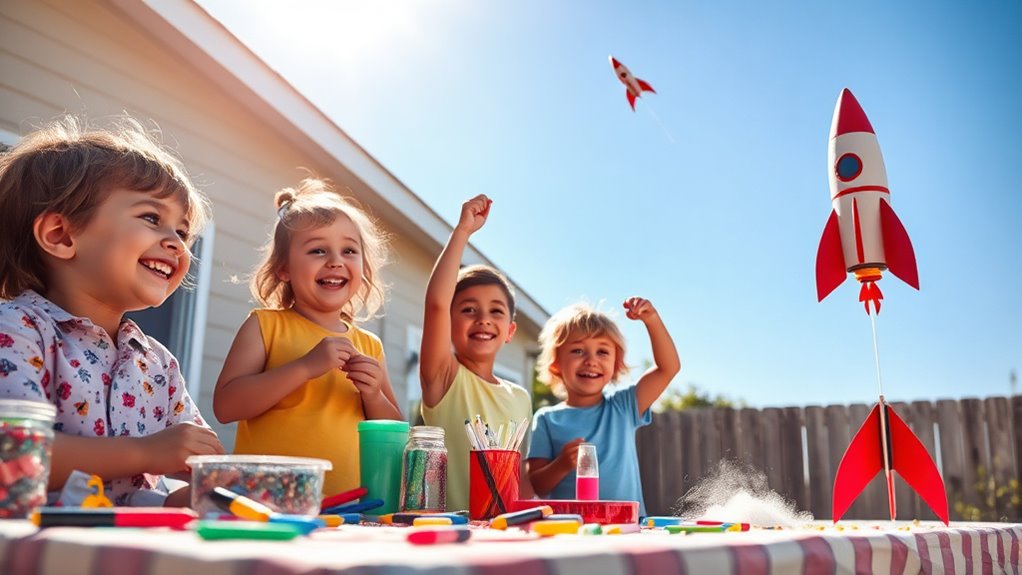
You can have a blast with your kids by exploring the exciting world of rockets and space together!
From creating simple rocket models using recycled materials to launching baking soda and vinegar rockets for a thrilling chemistry experiment, there are endless activities to enjoy.
Transform a cardboard box into a playful rocket ship that ignites their imagination, or craft a solar system model using painted spheres to learn about our cosmic neighborhood.
Design space-themed sensory bins filled with imaginative elements that engage their senses and creativity.
Plus, dive into fun space-related books and resources to expand their knowledge.
There’s so much more to discover in the world of rockets and space!
Key Takeaways
- Create simple rocket models using recycled materials, allowing kids to explore principles of flight while expressing their creativity through decoration.
- Launch homemade rockets with baking soda and vinegar in a safe outdoor environment, encouraging kids to experiment with different designs and document results.
- Set up a cardboard box rocket ship for imaginative play, complete with windows and themed props, to engage kids in space missions.
- Craft a solar system model using painted spheres, teaching children about planets while promoting hands-on learning through labeling and orbit creation.
- Design space-themed sensory bins filled with materials like black rice or blue gel beads, fostering imaginative play and fine motor skills development.
Create Simple Rocket Models With Recycled Materials
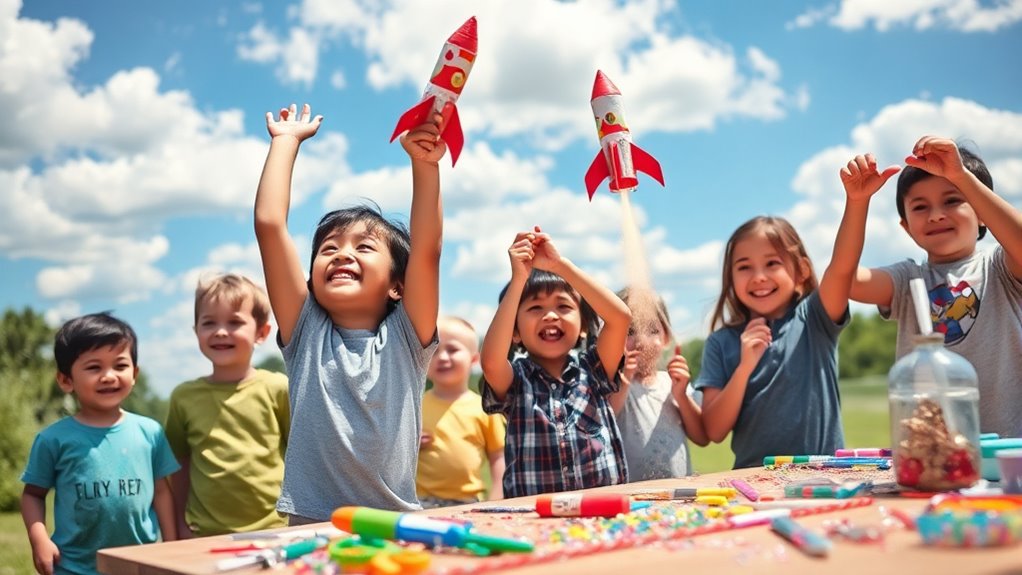
Creating rocket models from recycled materials is a fun and engaging way to spark creativity in kids.
Gather items like plastic bottles, cardboard tubes, and paper to get started.
You’ll want to cut fins from cardboard and attach them to the base of a bottle for added stability.
Encourage your children to express their individuality by decorating their rockets with markers, stickers, and paint.
This allows them to showcase their artistic flair while learning.
As you build together, discuss the principles of flight and space exploration to enhance their understanding.
When you’re ready for excitement, you can set up a new account for experimenting with launching the rockets using a baking soda and vinegar reaction, making science come alive!
Launch Baking Soda and Vinegar Rockets

Ready to launch your own baking soda and vinegar rocket? You’ll need a few simple materials and some straightforward steps to follow for a blast-off. Plus, don’t forget to keep safety in mind as you prepare for this explosive fun!
Materials Needed Overview
To launch baking soda and vinegar rockets, you’ll need a few essential materials.
First, grab a small plastic film canister or a similar container with a tight-fitting lid to hold your ingredients.
You’ll also need 1-2 tablespoons of baking soda and 1-2 ounces of vinegar; these are the key reactive ingredients that create the propulsion.
Make sure to work quickly, as the reaction produces carbon dioxide gas that builds pressure inside the canister.
It’s best to choose a safe outdoor space for the launch, allowing for easy cleanup and avoiding any mess indoors.
For added fun, encourage kids to decorate their rocket canisters with markers or stickers, personalizing their creations before liftoff!
Step-by-Step Instructions
Now that you have your materials gathered and your rocket canister decorated, it’s time to get ready for launch.
Start by filling your plastic film canister with about one tablespoon of vinegar.
Next, take a piece of paper towel and wrap one tablespoon of baking soda in it. This will delay the reaction.
Quickly drop the wrapped baking soda into the vinegar and seal the canister with its lid.
Flip it upside down and place it on the ground. Step back and watch as gas builds up, creating pressure.
The reaction produces carbon dioxide gas, launching your rocket into the air.
Enjoy the excitement of watching your homemade rocket soar!
Safety Precautions to Consider
While launching your baking soda and vinegar rocket can be an exciting experience, prioritizing safety is crucial.
Here are a few key precautions to keep in mind:
- Outdoor Launches: Always conduct your launches outside to avoid messy spills and guarantee a safe environment.
- Safety Goggles: Make sure everyone, including spectators, wears safety goggles to protect against splashes or debris.
- Distance: Maintain a safe distance of at least 10 feet between the rocket and all participants to prevent accidents.
Additionally, use a stable surface for launching to prevent tipping.
Supervise children closely, guiding them in following these safety protocols.
Set Up a Cardboard Box Rocket Ship
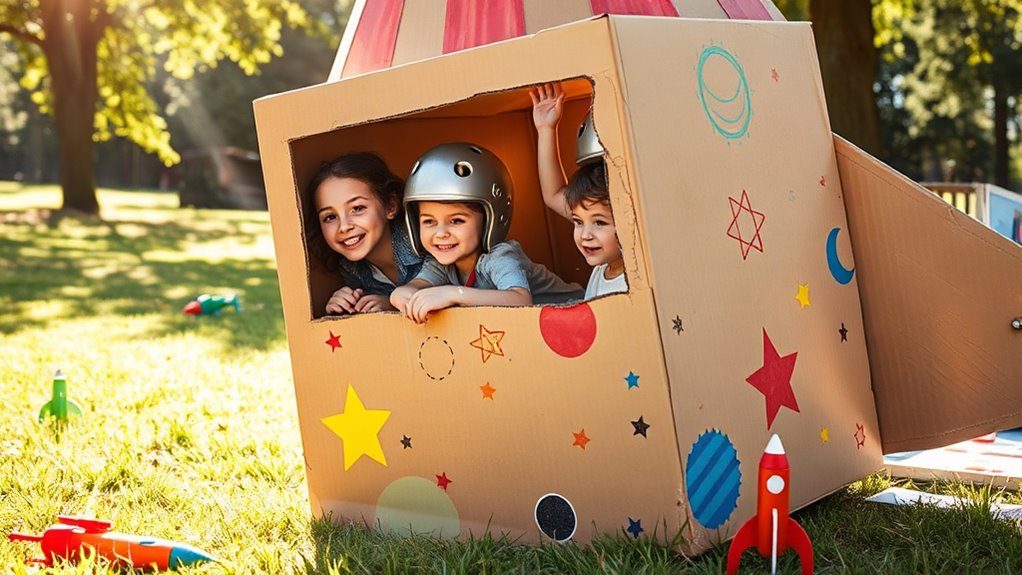
Creating a cardboard box rocket ship is a fun and imaginative project that can ignite your child’s creativity.
Start by transforming a large cardboard box—cut out windows and paint it in vibrant colors to capture their attention.
Encourage your kids to decorate their rocket with stickers, markers, or even aluminum foil, letting them personalize their spaceship.
For added excitement, use a smaller box or tube as a rocket launcher attached to the main structure.
Incorporate themed props like paper astronaut helmets to enhance role-playing and storytelling.
Organize space missions where your children can “blast off” in their cardboard rocket.
This promotes active play and imaginative adventures that transport them to the cosmos!
Craft a Solar System Model
Crafting a solar system model is a fun and educational project you can do with simple materials like foam balls and cardboard. You’ll follow a step-by-step guide to create each planet, scaling them to show their sizes relative to one another. This hands-on activity not only sparks creativity but also enhances your understanding of our celestial neighborhood.
Materials Needed for Model
Building a solar system model can be an exciting and educational project.
To get started, you’ll need a few essential materials that will bring your model to life.
Here’s a quick list to guide you:
- Spheres of Various Sizes: Use a large ball for the sun and smaller balls for each planet.
- Paint or Markers: Color the spheres to match the actual colors of the planets, enhancing the learning experience.
- Cardboard or Craft Foam: Create a base or backdrop that represents space, adding depth to your model.
You can also use string or fishing line to suspend the planets for a three-dimensional effect.
And don’t forget to sprinkle some glitter for a starry touch!
Enjoy the creative process!
Step-by-Step Construction Guide
With your materials ready, it’s time to bring your solar system model to life.
Start by painting the Styrofoam balls in vibrant colors—blue for Earth, red for Mars, and so on.
Make sure each planet’s size is proportional. Once dry, use skewers or wire to attach the painted balls to your sturdy base, representing their orbits around a larger ball for the sun.
Position the planets at varying distances to mimic their actual placements in space.
Encourage kids to label each planet with its name and fun facts to boost their learning.
Finally, add decorative touches like glitter for stars or sketch the asteroid belt.
This will make your solar system model visually engaging and a fantastic creative project!
Educational Benefits of Activity
While creating a solar system model, kids not only have fun but also gain a deeper understanding of planetary sizes, distances, and their order in relation to the sun.
This hands-on project offers several educational benefits:
- Fine Motor Skills: Cutting, painting, and assembling components enhance dexterity and coordination.
- Sensory Experience: Using various materials for planets helps kids recognize different textures and colors.
- Imaginative Play: Crafting stories about space exploration encourages creativity and critical thinking.
Additionally, discussing gravity and orbits during the process fosters an early interest in STEM topics.
Design Space-Themed Sensory Bins
Creating space-themed sensory bins offers a fantastic way to engage children’s imaginations while enhancing their tactile experiences.
Use materials like black rice or blue gel beads to mimic the night sky and oceans.
Incorporate small rocket toys, planet figurines, and shiny stars to spark imaginative play and storytelling about space adventures.
Add sensory elements such as foam balls for planets, glitter for stars, and textured fabrics to keep their senses engaged.
Utilize space-themed tools like scoops and containers so kids can practice fine motor skills while exploring the bin.
Periodically change the contents to introduce new elements, like alien figures or glow-in-the-dark stars, ensuring the sensory bin remains fresh and enchanting for ongoing learning and exploration.
Build Rockets Using Household Items
Building rockets using household items is a fun and creative way to spark children’s interest in science and engineering.
You can easily create exciting rocket models with just a few items around your home. Here’s how to get started:
1. Base: Use empty soda bottles as the rocket’s base.
Let your kids decorate them with markers and stickers for a personal touch.
2. Propulsion: Combine baking soda and vinegar in a small container attached to the bottle for a simple propulsion system that launches the rocket.
3. Stability: Cut triangular shapes from cardboard or paper to make fins.
Attach them to the bottle’s sides for better stability during flight.
Encourage your kids to document their designs and launch results for even more fun!
Explore Space-Related Books and Resources
After launching your homemade rockets, you can keep the excitement going by exploring space-related books and resources.
Immerse yourself in engaging stories like “The Darkest Dark” by Chris Hadfield and “There’s No Place Like Space” by Tish Rabe.
Dive into captivating tales like “The Darkest Dark” by Chris Hadfield and “There’s No Place Like Space” by Tish Rabe to fuel your child’s curiosity!
These titles spark curiosity about astronauts and space exploration, making STEM subjects fun!
Don’t forget to check out educational apps and websites that offer quizzes and fascinating facts about planets and stars.
You can also find science kits that let kids build rocket models or conduct exciting experiments.
Plus, many libraries and community centers host space-themed reading programs and events, giving your kids even more opportunities to learn and engage with their favorite topic.
Happy exploring!
Frequently Asked Questions
What Age Group Is Best for Rocket-Related Activities?
Kids ages 5 to 12 are best for rocket-related activities. They’re curious and enthusiastic to learn, making it the perfect time for you to engage them in exciting experiments and hands-on projects that inspire creativity.
How Can I Ensure Safety During Rocket Launches?
You guarantee safety during rocket launches by keeping a safe distance, wearing protective eyewear, and launching in open areas. Always check weather conditions, and follow instructions carefully for a fun, worry-free experience.
What Materials Are Best for Decorating Rocket Models?
You’ll want to use lightweight materials like stickers, paint, and colored paper for decorating rocket models. Craft foam and washi tape also add fun textures, while markers let you personalize your design with unique details.
How Long Do the Baking Soda and Vinegar Rockets Last?
Baking soda and vinegar rockets typically last just a few minutes during a single launch. However, you can reuse the materials multiple times, so you can enjoy several exciting launches in one session!
Can We Incorporate Math Concepts Into Rocket Activities?
While launching rockets, you can measure height and distance, calculating speed. Just like tracking a race car’s speed, you’ll turn math into an exciting adventure, making learning feel like a thrilling countdown!
Conclusion
As you plunge into these exciting rocket activities, picture your child’s eyes lighting up with wonder and curiosity.
From the fizzy eruption of baking soda rockets to the imaginative journeys aboard cardboard spaceships, every moment sparks creativity and exploration.
Surround yourselves with the twinkling stars of your solar system model and the rich tales of space-themed books.
Together, you’re not just learning about rockets; you’re igniting a lifelong passion for discovery that will launch their dreams into the cosmos.
Exploring rockets with your kids is truly a magical experience.
These activities not only engage their imagination but also pave the way for a love of science and space.
So, gear up for fun-filled adventures that will inspire curiosity and creativity, allowing them to dream big and reach for the stars!