7 Factors That Might Influence How Far a Toy Car Travels
Several factors can influence how far your toy car travels.
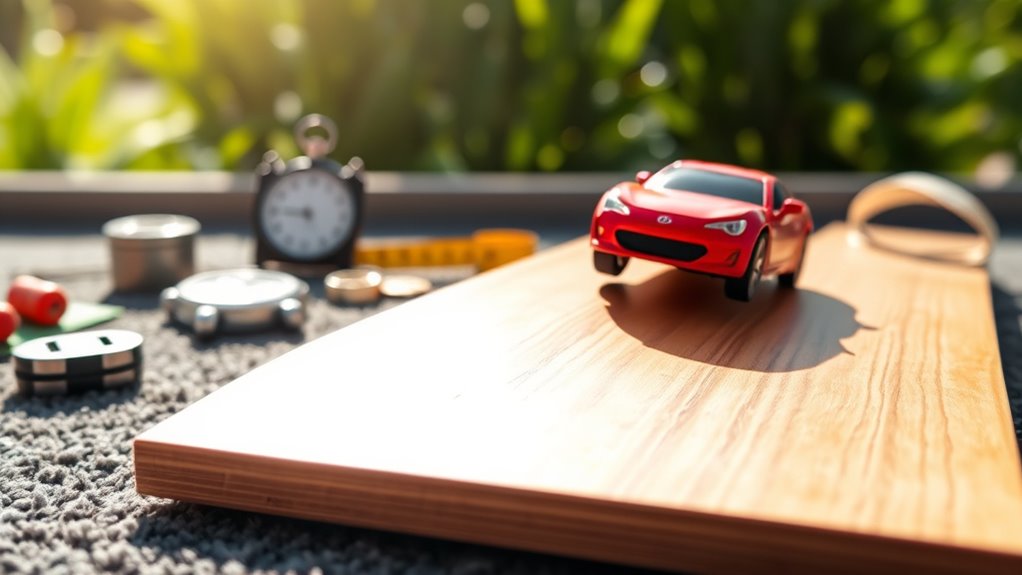
Understanding these elements can help you optimize your toy car’s performance. For instance, the ramp height and angle determine the potential energy converted to speed, which directly affects distance.
The surface material of the track plays a critical role too. Smoother surfaces typically result in less friction, allowing the car to travel longer distances.
Weight distribution within the car enhances its stability during movement.
Environmental factors, such as moisture, can also hinder how far the car goes by increasing friction.
Additionally, the type of car you’re using and the method of release are essential components to consider.
Explore these aspects further to reveal the secrets of toy car performance!
Key Takeaways
- Ramp height and angle significantly affect the potential energy and acceleration, influencing the distance traveled by the toy car.
- Surface material plays a crucial role, with smoother surfaces reducing friction and allowing for longer travel distances.
- Weight distribution impacts stability; a balanced weight leads to better rolling efficiency and distance.
- Environmental factors, such as surface texture and moisture, can either enhance or hinder the car’s movement.
- The type of toy car, including weight and wheel size, as well as the initial release method, greatly affects travel distance.
Ramp Height and Angle
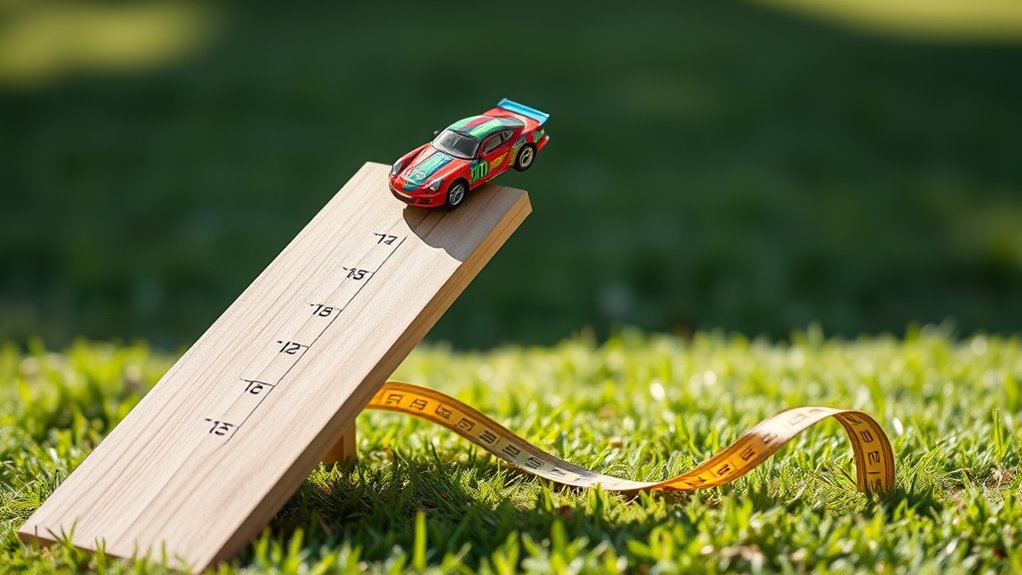
Have you ever wondered how ramp height and angle affect the distance your toy car travels?
The height of the ramp plays an essential role in determining the car’s potential energy, which is calculated with the formula PE = mgh.
As you increase the ramp height, the car gains more potential energy that converts to kinetic energy, resulting in greater speed as it exits the ramp.
A steeper ramp angle also enhances acceleration, allowing the car to pick up speed more quickly.
This increased initial velocity greatly impacts the distance the car travels after leaving the ramp.
Surface Material and Friction
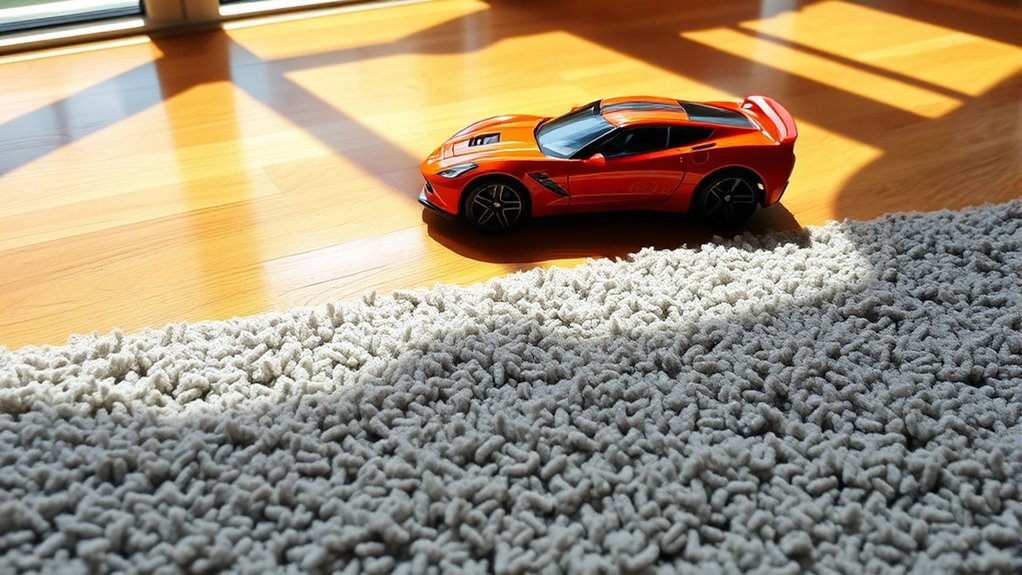
When you roll your toy car across different surfaces, you’ll quickly notice how much the surface material affects the distance it travels.
The friction between the car and the surface plays an essential role. Here are some key points to take into account:
- Smoother surfaces like tile reduce friction, allowing your car to glide further.
- Rough surfaces, such as carpet, increase friction, which shortens the distance the car travels.
- Different materials, like rubber and plastic, have varying coefficients of friction that impact speed.
Experimenting with these surface materials can be a fun way to understand the balance between friction and speed.
Exploring different surfaces with your toy car reveals the fascinating interplay between friction and speed.
You’ll find that even small changes in surface material can lead to surprising results in how far your toy car rolls!
Weight Distribution of the Toy Car
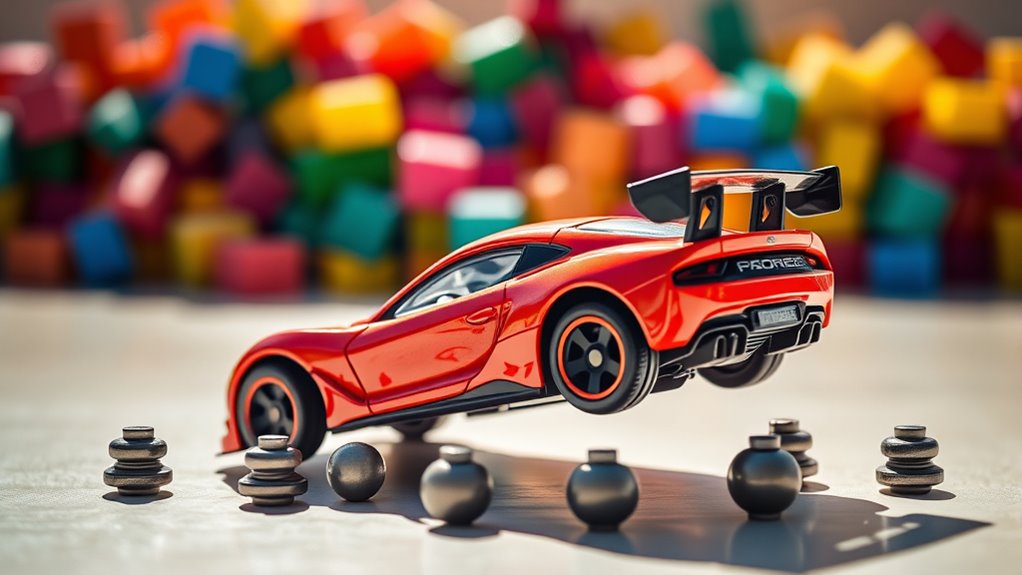
After exploring how surface material impacts your toy car’s journey, it’s time to contemplate another significant aspect: weight distribution.
The way weight is distributed in your car plays a considerable role in its stability and rolling efficiency. Cars with a lower center of gravity often have better weight distribution, enhancing both speed and distance traveled.
If the weight is uneven, your toy car might veer off course, resulting in a shorter travel distance.
By ensuring a balanced weight distribution, you can help your car maintain momentum effectively as it moves.
Experimenting with different configurations can reveal that cars with centralized weight distribution consistently achieve greater distances.
Environmental Factors
When you set up your toy car ramp, pay attention to the surface texture; it can greatly affect how far your car travels. A smooth surface allows for better movement, while rough textures increase friction and slow it down. Also, make sure the incline angle is consistent, as any variations can change how gravity impacts your car’s speed and distance.
Surface Texture Impact
Surface texture plays an essential role in how far your toy car can travel.
The friction created by different surfaces directly impacts the distance and time your car rolls.
Smoother surfaces, like hardwood, typically allow for longer travel distances compared to rougher ones, such as carpet.
Here are some key points to evaluate:
- A toy car might travel 2 meters on carpet but up to 5 meters on a hardwood floor.
- Moisture or dirt can reduce grip, causing your car to slide instead of roll smoothly.
- Experimenting on various surface textures helps you understand the relationship between surface characteristics and car performance.
Incline Angle Effects
The incline angle of a ramp can dramatically change how far your toy car travels. Steeper angles increase acceleration and distance.
With a higher incline angle, the potential energy at the ramp’s top converts to kinetic energy more efficiently at the bottom.
For instance, a ramp with a 30-degree incline can propel your toy car nearly double the distance compared to a 10-degree incline.
| Incline Angle | Distance Traveled |
|---|---|
| 10 degrees | Short Distance |
| 30 degrees | Nearly Double |
| 45 degrees | 1.5 Times Farther |
| Flat Surface | Minimal Distance |
This relationship between incline angle and energy conversion is key to maximizing your toy car’s travel distance.
Air Resistance
As your toy car zooms along, air resistance, or drag, pushes against it, making a significant impact on its speed and distance.
This force increases with the speed of the car, meaning faster cars face more resistance, which can shorten their travel distance.
The design of the toy car also plays an essential role in determining how much air resistance it faces.
Streamlined shapes experience less drag.
Heavier cars can maintain momentum better against air resistance.
Environmental conditions, like wind, can enhance or reduce drag.
Type of Toy Car
While air resistance plays a role in the performance of toy cars, the type of car you choose can have an even more significant impact on how far it travels.
Lightweight plastic cars often outpace heavier metal ones when released from the same height, thanks to reduced inertia.
Additionally, toy cars with larger wheels tend to experience less friction with the surface, enabling them to cover greater distances.
If you opt for a car with an aerodynamic design, you’ll likely notice even less air resistance, further enhancing its travel distance.
Experiments show that streamlined race cars can achieve noticeably higher speeds and longer distances compared to standard toy cars.
This really emphasizes how design directly influences motion.
Initial Release Method
How does the way you release a toy car affect its travel distance?
The initial release method plays an important role in determining how far the car will go.
The way you release a toy car significantly influences its travel distance.
By adjusting factors like the height of the ramp and the force of your release, you can greatly change the outcome.
Releasing from a greater height boosts potential energy, converting it into kinetic energy.
But if you do a gentle release, it might not maximize the car’s speed, which could limit how far it travels.
Also, a horizontal release angle is a great way to optimize travel distance on flat surfaces.
Consistency in your release method across trials is essential for accurate comparisons.
Frequently Asked Questions
How Does Temperature Affect the Performance of a Toy Car?
Temperature affects your toy car’s performance by altering the viscosity of lubricants and hardening or softening materials. Extreme temperatures can reduce traction, increase resistance, and impact battery efficiency, ultimately affecting how far it travels.
Can the Color of the Toy Car Impact Its Speed?
Yes, the color of your toy car can impact its speed slightly. Darker colors absorb more heat, potentially softening the material, but other factors like weight and surface friction usually play a more significant role.
What Role Does the Wheel Size Play in Distance Traveled?
Wheel size plays an essential role in distance traveled, like the difference between a sprinter and a marathon runner. Larger wheels reduce rolling resistance, allowing your toy car to glide farther on smooth surfaces.
Do Toy Car Materials Affect Durability and Distance?
Yes, toy car materials affect durability and distance. Lightweight plastics usually allow for farther travel, while harder materials enhance durability. Softer materials might deform, reducing efficiency and resulting in shorter distances. Choose wisely!
How Does the Design of the Ramp Influence the Car’s Trajectory?
Did you know that a ramp’s curvature can increase distance by up to 30%? The design influences the car’s trajectory, affecting speed and stability, ultimately determining how far the car travels once it rolls off.
Conclusion
In summary, remember that ramp height and angle,
surface material and friction, weight distribution,
environmental factors, air resistance, type of toy car,
and initial release method all play an essential role
in how far your toy car travels.
By experimenting with these factors, you can maximize
your toy car’s distance, enhance your understanding
of physics, and have fun while doing it.
So, get ready to race, adjust your setup,
and watch your toy car soar!
In conclusion, the distance your toy car can travel
is influenced by several key factors.
By focusing on ramp height, surface material, and
other elements, you can improve your toy car’s performance.
So, dive into this exciting experiment,
and enjoy learning about physics while having fun with your toy car!