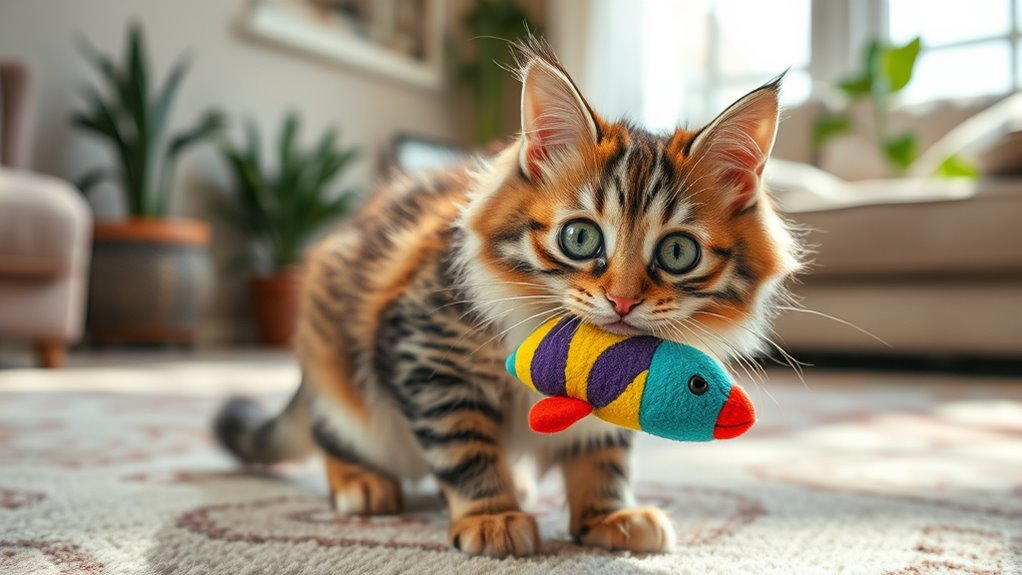
Why Does My Cat Carry Around a Toy and Meow?
When your cat carries around a toy and meows, it’s expressing trust and affection.
This behavior mimics their instincts to hunt and capture prey.
By bringing a toy to you, your cat invites you to join in on the playful hunt, showing that they value your companionship.
Their unique meows often signal excitement or a desire for attention.
If you want to learn more about what this adorable habit means, there’s plenty more to explore.
Understanding your cat’s behavior can enhance your bond and make playtime even more enjoyable!
Key Takeaways
- Cats carry toys as a sign of affection and trust, mimicking the behavior of mother cats bringing prey to their kittens.
- Meowing while presenting a toy often indicates a desire for play and interaction with their human companions.
- This behavior reflects their instinctual hunting nature, treating toys as prey to engage in predatory play.
- Carrying toys invites owners into their playful hunting experience, reinforcing the emotional bond between cat and human.
- Engaging in short play sessions with toys helps satisfy a cat’s social and instinctual needs, promoting overall well-being.
Understanding the Behavior: a Gift From Your Cat
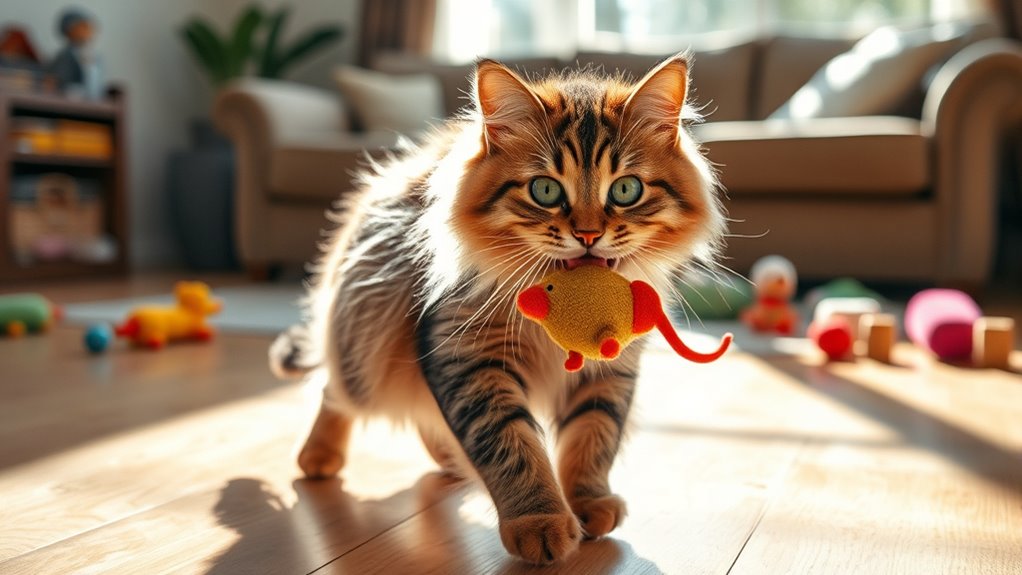
Have you ever wondered why your cat brings you their favorite toy?
This behavior isn’t just a playful act; it’s a meaningful gesture. When your cat carries a toy and meows, they’re expressing trust and affection.
They want you to feel safe in their inner circle, much like a mother cat bringing prey to her kittens. By presenting their “trophy,” your cat showcases their instincts and capabilities, inviting you to engage with them.
This ritual reinforces your bond, allowing both of you to connect on a deeper level.
So, when your furry friend drops that toy at your feet, take a moment to appreciate their gesture of love.
Reciprocate with praise to strengthen your relationship!
The Role of Meowing in Cat Communication
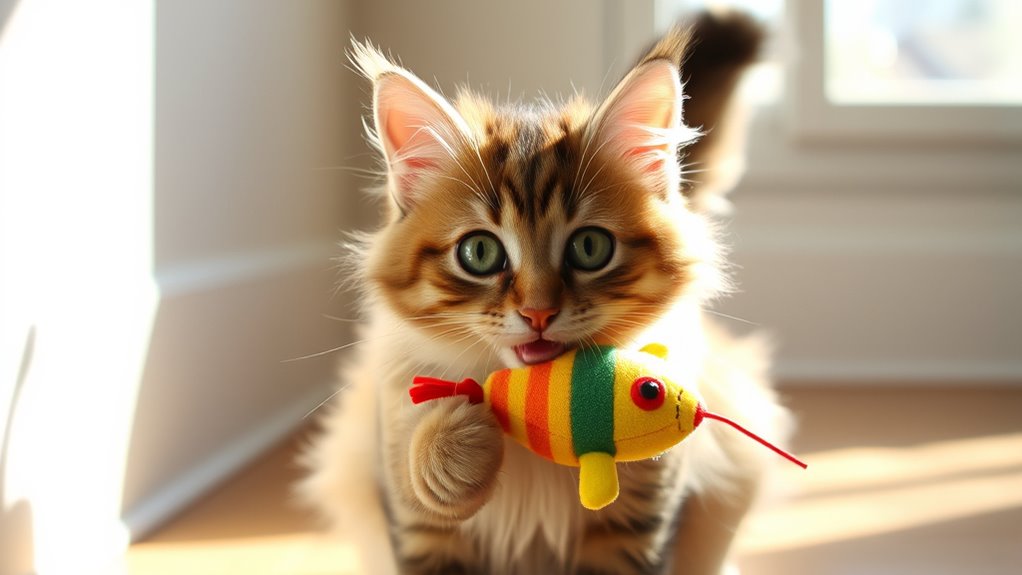
Many people don’t realize that meowing is a cat’s primary way of communicating with humans.
Unlike their interactions with other cats, your feline friend has evolved this vocalization specifically for you.
When your cat drops a toy and meows, it often signals a desire for playtime or interaction.
This behavior can express affection, showing that they see you as family.
Additionally, meowing while presenting a toy can indicate restlessness or boredom, prompting you to engage them in play.
Each cat has its unique meow, varying in tone and frequency, reflecting their personality and specific requests.
| Meow Type | Meaning |
|---|---|
| Short and high | Excitement or greeting |
| Long and low | Displeasure or annoyance |
| Soft and gentle | Affection or comfort |
| Repeated meows | Request for attention |
Instinctual Hunting: Toys as Prey
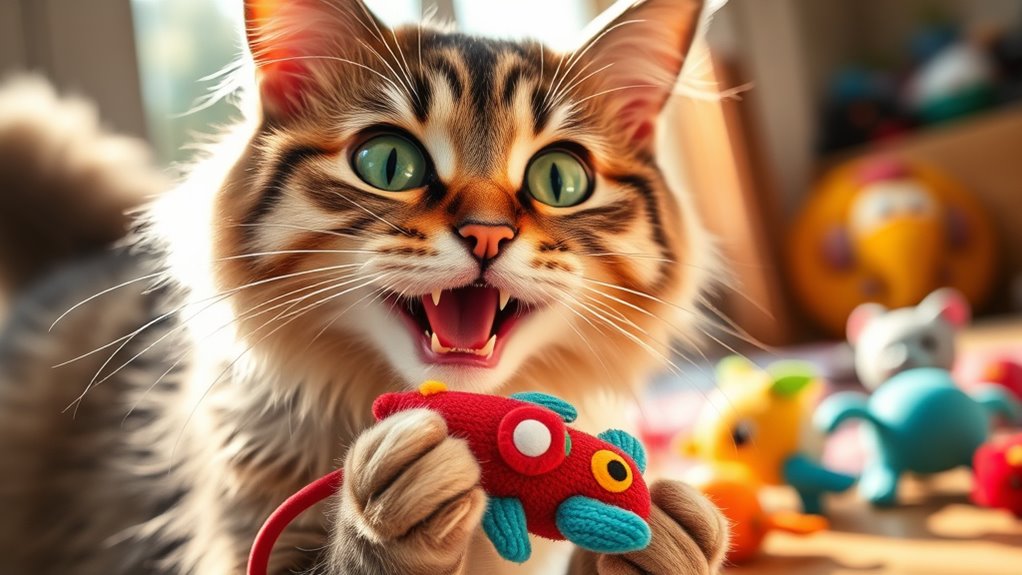
When your cat carries around toys, it’s not just playing—it’s mimicking the natural hunting behavior of its wild ancestors. This instinctual act transforms toys into captured prey, showcasing their skills as hunters. You might even notice your cat proudly presenting its “catch” to you, reinforcing the bond between you both.
Mimicking Natural Hunting Behavior
Cats instinctively mimic their natural hunting behavior by treating toys as prey, showcasing their innate predatory skills even in a domestic environment.
When you see your cat carrying a toy in its mouth, it’s channeling its instinct to hunt and capture.
This behavior mirrors how wild cats carry their catch back to a safe spot, often to present it to their kittens.
Your cat perceives specific toys as substitutes for prey, engaging in stalking, pouncing, and carrying them around.
By simulating these hunting scenarios indoors, your cat expresses its predatory nature and fulfills its instinctual needs.
Providing appropriate toys that resemble prey can enhance this behavior, ensuring your feline friend remains mentally stimulated and satisfied.
Toys as Captured Prey
There’s something instinctual about how your cat interacts with toys, treating them as if they’ve caught real prey.
When your cat carries a toy in its mouth, it’s mimicking the natural hunting behavior ingrained in its DNA.
Even indoor cats retain this drive, showcasing their instinct to capture and carry items they see as trophies.
By bringing toys to you, your cat might be sharing its “catch,” inviting you into its hunting experience.
The accompanying meowing often signifies excitement and engagement, emphasizing their predatory nature even in your home.
This behavior isn’t limited to one breed; it’s a universal trait seen across various feline species.
It highlights the deep-rooted instincts that connect all cats to their wild ancestors.
Engaging With Your Cat: How to Respond
Engaging with your cat can be a rewarding experience, especially when they drop a toy at your feet and meow, signaling their desire for play.
Acknowledge this gesture with gentle praise to strengthen your bond.
Short play sessions satisfy their hunting instincts and social needs.
Here’s a quick guide to enhance your interactions:
| Action | Benefit |
|---|---|
| Praise your cat | Reinforces emotional connection |
| Rotate toys | Keeps them stimulated |
| Observe preferences | Tailors playtime experience |
| Engage in short bursts | Fulfills instinctual needs |
The Importance of Playtime and Stimulation
Playtime isn’t just fun; it’s essential for your cat’s well-being. Engaging in activities that stimulate their minds and satisfy their natural instincts keeps them happy and healthy. By incorporating a mix of toys and interactive play, you’ll help prevent boredom and strengthen your bond.
Engaging Play Activities
While you might think of play as just a fun pastime for your cat, it actually plays an essential role in their overall well-being.
Engaging in play activities satisfies their natural predatory instincts and prevents boredom. Interactive toys, like feather wands and crinkle balls, encourage physical activity and mental stimulation.
Regular play sessions not only provide exercise but also strengthen the bond between you and your cat.
To keep things interesting, rotate toys and introduce variety. This reduces restlessness and promotes healthy behavior.
Remember, short, frequent play sessions are often more effective than longer ones. This approach caters to your cat’s attention span.
| Toy Type | Activity | Benefit |
|---|---|---|
| Feather Wand | Chase and pounce | Exercise and agility |
| Crinkle Ball | Bat and chase | Mental stimulation |
| Laser Pointer | Follow the light | Physical activity |
| Catnip Toy | Sniff and wrestle | Stress relief |
| Puzzle Feeder | Solve and snack | Cognitive challenge |
Mental Stimulation Needs
Cats thrive on mental stimulation, just as much as they do on physical activity.
Indoor cats have strong predatory instincts that need to be satisfied through engaging playtime. Without it, they may resort to boredom-related behaviors.
Here are three ways to enhance your cat’s mental stimulation:
- Interactive Toys: Use feather wands and puzzle feeders to encourage your cat’s natural instincts and provide mental exercise.
- Rotate Toys: Regularly switching out toys keeps the environment fresh and exciting, maintaining your cat’s interest.
- Playtime Routine: Establish a consistent play schedule to strengthen your bond and help alleviate stress or anxiety.
Individual Preferences: What Your Cat Likes
Understanding what your cat likes can greatly enhance your time together.
Each cat has unique preferences, so while one may chase a feathered wand, another might prefer a crumpled piece of paper or even a sock.
Your cat’s personality profoundly influences how they interact with their toys, leading to different play styles.
By observing which toys spark the most excitement, you can choose the best items to satisfy their playful instincts.
It’s important to experiment with various types to discover what truly engages your feline friend.
This tailored approach not only enriches playtime but also fosters a deeper bond between you and your pet.
Making every moment spent together more enjoyable and fulfilling is the goal!
Frequently Asked Questions
Is My Cat Trying to Show off Their “Catch”?
Yes, your cat’s likely showing off their “catch.” By carrying the toy around and meowing, they’re inviting you to engage, reinforcing your bond and embracing their instinctual need to share their hunting success with you.
Why Do Some Cats Prefer Specific Toys Over Others?
“Different strokes for different folks.” Your cat prefers specific toys because of their texture, sound, or scent. Personal experiences and individual personality shape these choices, making certain toys irresistible in their playful world.
Can This Behavior Indicate Anxiety or Stress?
Yes, this behavior can indicate anxiety or stress. If you notice excessive toy carrying and vocalization, it’s important to assess your cat’s environment for potential stressors and provide enrichment to help alleviate their unease.
How Can I Encourage My Cat’s Playful Behavior?
Did you know that 70% of cats thrive with regular play? To encourage your cat’s playful behavior, engage in interactive sessions, rotate toys, and offer praise. Short, frequent playtimes keep them excited and mentally stimulated!
Do Certain Breeds Exhibit This Behavior More Than Others?
Yes, certain breeds do exhibit this behavior more than others. Breeds like Siamese and Bengals often carry toys and vocalize more, driven by their social nature or strong hunting instincts, respectively. Individual personality also plays a role.
Conclusion
To sum up, when your cat carries around a toy and meows, it’s expressing affection, showcasing instincts, and seeking attention.
It’s a gift of love, a reminder of their hunting prowess, and an invitation for play.
By understanding their behavior and responding with engagement, you’re nurturing their happiness.
So, embrace their quirks and celebrate their uniqueness.
Enjoy the bond you share with your feline friend.
Your cat’s playful antics are just another way of saying, “I care.”
In conclusion, recognizing why your cat carries toys and meows can deepen your connection.
It’s all about love, instinct, and interaction.
So, engage with your cat, provide stimulation, and enjoy those moments together.
Your cat’s behavior is a beautiful expression of their personality and affection.