What Makes a Great Radio Controlled Car Controller?
A great radio-controlled car controller is essential for enthusiasts seeking optimal performance. Key features like adjustable endpoints and advanced telemetry can significantly enhance your driving experience.
Ergonomic design is crucial, as it helps to reduce hand fatigue during long races. Customizable controls also allow you to tailor your setup to fit your preferences perfectly.
Reliable communication is another important aspect, ensuring you maintain control at greater distances without interference.
Plus, compatibility with various racing styles can enhance your overall experience.
Since user preferences vary widely, tapping into community insights can greatly assist you in choosing the right model.
If you want to know more about what to look for, keep exploring!
Key Takeaways
- Adjustable endpoints and fine-tuning options enhance throttle and steering control for improved performance in various driving conditions.
- Ergonomic designs with comfortable grips and intuitive button placements reduce fatigue and improve user experience during extended sessions.
- Reliable signal transmission with extended range and frequency-hopping technology minimizes erratic movements and enhances overall control.
- Advanced telemetry features provide real-time feedback on battery performance, allowing for better management during races or off-road adventures.
- Customizable layouts and multiple model programming cater to user preferences, making controllers versatile for both beginners and experienced racers.
Essential Features of RC Car Controllers
When it comes to choosing an RC car controller, several essential features can greatly enhance your driving experience.
Years ago, basic controllers offered limited functionality, but today’s models include adjustable endpoints.
Today’s RC car controllers offer advanced features like adjustable endpoints, enhancing performance beyond the limitations of basic models from years past.
This feature lets you fine-tune throttle and steering ranges for ideal performance.
Advanced telemetry provides real-time insights on battery voltage, temperature, and signal strength, keeping you informed while driving.
Built-in gyros considerably improve stability and control, especially in high-speed or off-road situations.
Plus, multiple channels allow you to control additional functions like lights or winches, making your setup more versatile.
Ergonomics and Comfort in Design
Choosing a radio-controlled car controller that prioritizes ergonomics and comfort can greatly enhance your driving experience.
Look for designs with comfortable grips and intuitive button placements to reduce hand fatigue during long sessions.
A controller with adjustable handle positions and customizable button layouts can cater to your personal preferences, making it easier to control your vehicle.
Lightweight materials also play a significant role, allowing you to maneuver effortlessly without straining your wrist.
Ascertain the controller shape promotes a natural hand position, accommodating different grip styles, whether you prefer a steering wheel or stick configuration.
Additionally, controllers featuring tactile feedback and responsive controls help you feel connected to your vehicle while maintaining comfort throughout your driving adventure.
Customization and Adjustability for Performance
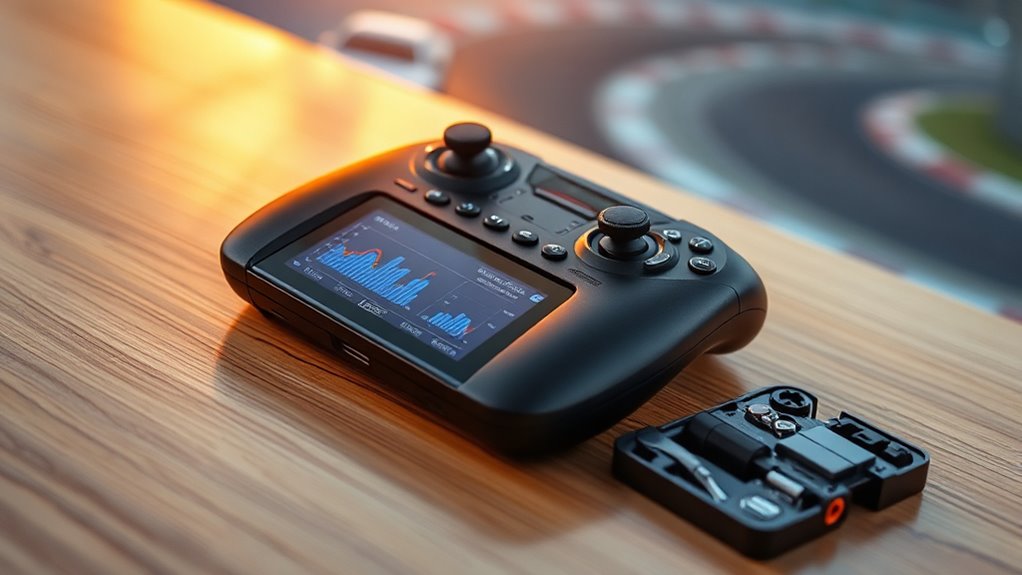
Customization and adjustability can greatly enhance your radio-controlled car’s performance, enabling you to tailor the setup to your specific driving style.
High-end radios, like the Futaba 10PX, offer options for fine-tuning endpoint adjustments, exponential rates, and dual rates. This allows you to achieve a personalized driving experience.
Many aftermarket radios come equipped with telemetry features, providing real-time feedback on battery voltage and temperature. This helps you monitor and adjust performance effectively.
Additionally, models like the Radiolink RC6GS let you program multiple models into one transmitter, improving flexibility.
Built-in gyros in radios like the Dumbo RC enhance stability and handling in tough conditions.
Finally, customizable control layouts allow you to experiment with throttle and steering assignments for peak control.
Communication and Signal Reliability
When you’re out racing your radio-controlled car, reliable communication is key to keeping control. Understanding signal range and how to mitigate interference can make all the difference in your experience. Plus, ensuring your receiver is compatible and in good condition will help you maintain a strong connection for peak performance.
Signal Range Importance
The signal range of your radio-controlled car controller plays an essential role in ensuring smooth and reliable operation.
A greater signal range allows you to maneuver your car farther away without losing control, which is vital for an enjoyable experience.
Here are some key considerations:
- Typical Ranges: Expect 100 meters to over 1 kilometer in high-end models.
- Consistent Control: A reliable signal minimizes the chance of crashes or erratic movements.
- Advanced Technology: Look for controllers with frequency-hopping spread spectrum for enhanced reliability.
- Antenna Quality: Strong antennas on both the transmitter and receiver extend the effective signal range.
When evaluating signal range, always consider terrain and obstacles that could hinder communication between you and your car.
It’s important to keep these factors in mind to ensure the best experience with your radio-controlled car!
Interference Mitigation Techniques
To maintain control of your radio-controlled car, you need to think about how to mitigate interference that can disrupt communication.
Modern RC controllers often use frequency hopping spread spectrum (FHSS) technology, which rapidly switches frequencies to reduce interference risks.
Look for systems with diversity receivers. These employ multiple antennas for better signal reception, even in challenging environments.
Some controllers come equipped with built-in telemetry systems. This allows you to monitor signal strength in real-time and adjust your setup accordingly.
Advanced protocols like DSMX enhance reliability in interference-prone situations.
Finally, opting for a controller with higher transmission power can greatly boost your signal range and reliability. This helps minimize the chances of losing control due to interference.
Receiver Compatibility Considerations
Verifying your receiver is compatible with your transmitter is vital for maintaining effective communication and signal reliability.
Not all transmitters can communicate with every receiver, so check the operating frequency and modulation type.
Here are some key factors to take into account:
- Environmental Impact: Be aware of potential interference from other electronic devices or obstacles that could disrupt signals.
- Diversity Antennas: Look for modern receivers with diversity antennas to enhance signal reception in challenging conditions.
- Receiver Range: Higher-quality receivers often provide greater distances for uninterrupted signal transmission, essential for outdoor racing.
- Telemetry Features: If you want real-time data feedback, confirm your receiver is compatible with telemetry-enabled transmitters for peak performance.
Keeping these factors in mind will help you choose the right equipment for the best experience!
Compatibility With Different Racing Styles
When choosing a controller, think about your racing style. Electric racers often prefer steering wheels for that authentic feel, while nitro racers lean towards stick radios for better throttle control. You might even find a unique setup that fits your personal driving style perfectly.
Steering Wheel vs. Stick
How do steering wheel controllers and stick radios measure up when it comes to different racing styles?
Steering wheel controllers have surged in popularity, offering a realistic experience that suits electric racing. However, many electric racers can become “trigger happy,” potentially hindering performance.
Stick radios, on the other hand, are the go-to for nitro racers. They provide precise throttle and gas control, which top drivers like Lamberto Collari and Michael Salven rely on.
Steering wheels enhance realism, making them ideal for electric racing.
Stick radios allow for fine-tuned gas control, which is favored by nitro racers.
Unique setups, like having the throttle on the right, show adaptability among different users.
Each style caters to different driving preferences, ultimately enhancing the racing experience.
Nitro vs. Electric Preferences
Which control type suits your racing style better: nitro or electric?
Nitro racers often gravitate toward stick radios, allowing for precise throttle modulation during races. This control type helps you manage varying speeds effectively.
On the other hand, if you’re an electric racer, you might prefer steering wheel controls. They offer an intuitive, responsive experience that aligns well with electric vehicles’ quick acceleration.
This preference often leads to a “trigger happy” driving style, ideal for fast-paced racing.
Historical trends show that legends like Lamberto Collari and Michael Salven used stick radios, reinforcing this nitro preference.
Experimenting with control configurations, such as switching throttle stick positions, can help you adapt your style and improve your performance on the track.
User Preferences and Community Insights
Although preferences for radio controlled car controllers can vary greatly among users, many enthusiasts find joy in shifting from high-end models to more budget-friendly options.
Popular choices like the Flysky GT3B and GT5 are praised for their user-friendliness, making them attractive to both beginners and seasoned racers.
Here are some insights from the community:
- Personal Experiences: Enthusiasts share valuable tips on forums like RC Talk.
- Budget-Friendly Choices: Many casual racers find satisfaction without splurging on high-end features.
- Local Support: Hobby shops foster discussions that help shape preferences and build connections.
- Advanced vs. Basic: While high-end models offer telemetry, budget options often meet casual needs effectively.
Engaging with the community can truly enhance your experience!
Frequently Asked Questions
How Do I Maintain My Radio-Controlled Car Controller?
To maintain your radio-controlled car controller, regularly check and replace batteries, clean its exterior, inspect the antenna for damage, store it properly, and update firmware as needed. This guarantees peak performance and longevity.
What Is the Average Lifespan of an RC Car Controller?
The average lifespan of an RC car controller ranges from 3 to 10 years. If you maintain it properly and protect it from harsh conditions, you can greatly extend its longevity and performance.
Can I Use a Controller From One Brand With Another Brand’s Car?
Can you really use a controller from one brand with another brand’s car? Generally, you can’t—compatibility issues often arise. Always check specifications and user manuals to verify your gear will work together properly.
What Should I Do if My Controller Connection Is Lost?
If your controller connection’s lost, check battery levels, make certain you’re within range, inspect the receiver for damage, re-bind the transmitter, and look for interference. If problems persist, seek help from community resources or hobby shops.
Are There Any Common Troubleshooting Tips for RC Car Controllers?
Yes, check battery levels, guarantee proper binding between transmitter and receiver, inspect antennas for damage, and clean controls regularly. If problems persist, try changing frequency or channel settings to improve signal reliability.
Conclusion
To sum up, a great RC car controller combines essential features, comfort, and reliability to enhance your racing experience.
You might think that high-end controllers are only for serious racers, but that’s not the case.
With the right balance of ergonomics and customization, even casual hobbyists can benefit.
Investing in a quality controller can elevate your skills and enjoyment, regardless of your experience level.
So, whether you’re racing competitively or just for fun, choosing the right controller is key.
It truly makes a difference in maximizing your performance and overall experience.
In the end, the right RC car controller can transform your racing game.
So, don’t overlook the importance of comfort, features, and reliability when making your choice!