What Are Small Rockets and How Do They Function?
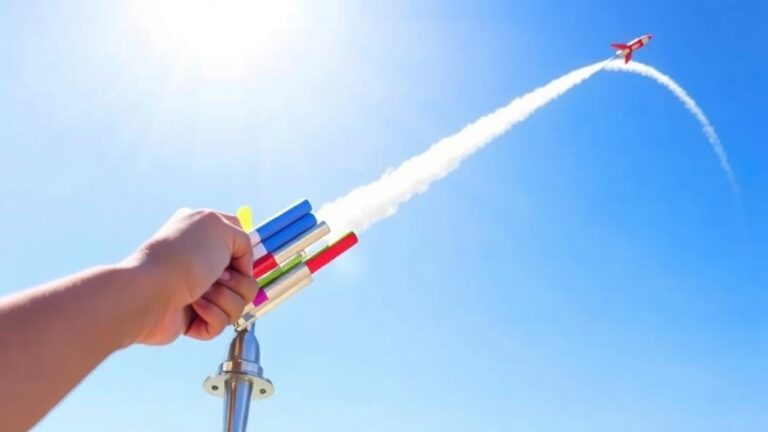
Small rockets, often referred to as sounding rockets, play a crucial role in scientific exploration.
They operate on the fundamental principle of propulsion, generating thrust through the expulsion of gas.
Typically powered by solid propellants, these rockets can soar to impressive altitudes of up to 200 kilometers.
Their design includes essential components such as engines, fuel tanks, and payloads that often carry scientific instruments.
To ensure safety during launches and recoveries, systems like parachutes and guidance controls are implemented.
There’s a wealth of information to uncover about the functions and benefits of small rockets!
Key Takeaways
- Small rockets, or sounding rockets, are designed for atmospheric research, reaching altitudes up to 200 kilometers.
- They operate based on Newton’s Third Law, where gas expulsion generates thrust.
- Powered mainly by solid propellants, small rockets offer simplicity and reliability for quick launches.
- Key components include the rocket engine, fuel tanks, payload, and guidance system for stability.
- Safety measures, including pre-launch checks and monitoring weather conditions, ensure secure launches and operations.
Overview of Small Rockets

Small rockets, often called sounding rockets, play an essential role in scientific exploration and atmospheric research.
You’ll find these rockets designed for quick and cost-effective launches, reaching altitudes of up to 200 kilometers (124 miles).
The science behind their operation relies on Newton’s Third Law of Motion; as gas is expelled from the rocket engine, it generates an equal and opposite force that propels it upward.
Typically powered by solid propellants, small rockets offer simplicity and reliability, making them ideal for suborbital missions.
They’re vital for testing new technologies and gathering data that support future space missions and scientific studies.
The Science Behind Rocket Propulsion
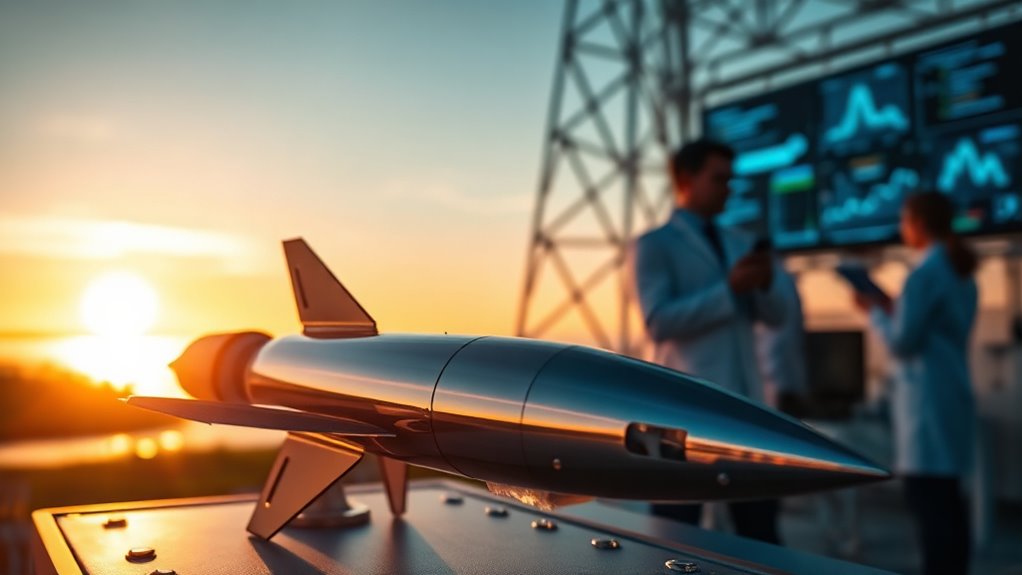
Understanding how small rockets function leads us to the fascinating science behind rocket propulsion.
At its core, rocket propulsion is driven by Newton’s Third Law of Motion. When gas is expelled from the engine, the rocket experiences thrust that pushes it upward.
Here are some key points to contemplate:
- Rockets use solid or liquid propellants for thrust generation.
- Solid propellants burn in a fixed shape, while liquid ones offer combustion control.
The engine, fuel tanks, and nozzle make up the propulsion system.
Overcoming Earth’s gravity and atmospheric drag is essential during launch.
Effective rocket propulsion is imperative for successful space exploration.
This knowledge is significant for developing launch vehicles that can carry payloads beyond our planet’s atmosphere.
Components of a Small Rocket
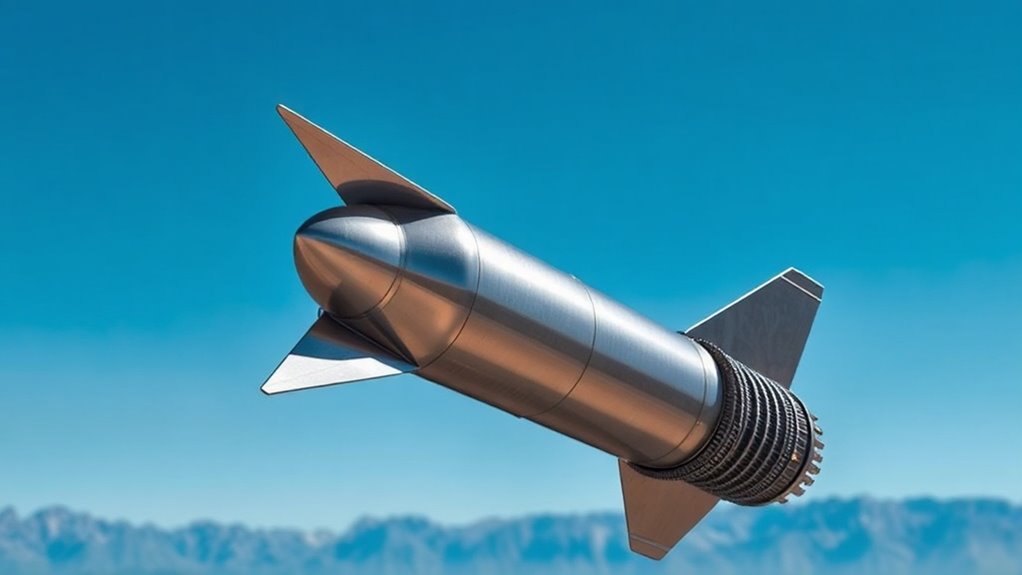
When it comes to the components of a small rocket, several vital parts work together to secure a successful flight.
The rocket engine generates thrust by expelling exhaust gases, adhering to Newton’s Third Law of Motion.
You’ll find various fuel types, including solid, liquid, and hybrid systems, each designed for efficient combustion.
The payload can vary, encompassing scientific instruments or miniature satellites intended for specific tasks once in orbit.
Finally, the guidance system plays an essential role in maintaining stability and control, utilizing sensors and onboard computers for trajectory adjustments.
| Component | Description |
|---|---|
| Rocket Engine | Generates thrust through exhaust gases |
| Fuel | Types include solid, liquid, or hybrid systems |
| Payload | Can be scientific instruments or satellites |
| Guidance System | Guarantees stability and control during flight |
Stability and Recovery Systems
When launching small rockets, stability control mechanisms like fins or canards play an essential role in keeping your rocket on a straight path. After reaching its peak, recovery techniques, such as parachutes, guarantee a safe descent for reuse. Understanding these systems is key to mastering rocket flight and safety.
Stability Control Mechanisms
Stability control mechanisms play an essential role in small rockets, guaranteeing they follow the intended flight path without tumbling or oscillating during ascent.
These systems leverage advanced technologies to maintain stability and enhance performance. Here are some key components:
- Gyroscopes and accelerometers: These devices provide real-time data on orientation and velocity.
- Active control systems: They include gimbaled engines and movable fins for thrust vector adjustments.
- Feedback loops: These enable continuous monitoring and rapid response to instability.
- Aerodynamic design: This guarantees the rocket’s shape promotes stable flight.
- Real-time adjustments: They allow for immediate corrections during flight to maintain trajectory.
It’s pretty fascinating how these technologies work together to ensure a smooth flight!
Recovery Techniques Overview
Maintaining stability during ascent is only part of the journey for small rockets; recovery techniques are just as critical for guaranteeing a safe return.
Most small rockets use parachutes that deploy at a predetermined altitude, allowing for a controlled descent after reaching peak altitude.
The design of fins or canards guarantees a straight flight path during ascent.
But recovery systems must also be well-matched to the rocket’s weight and shape.
Factors like parachute size can greatly influence effectiveness.
Some rockets even feature advanced recovery methods, such as deployable wings or gliding capabilities, enabling them to navigate back to specific landing zones.
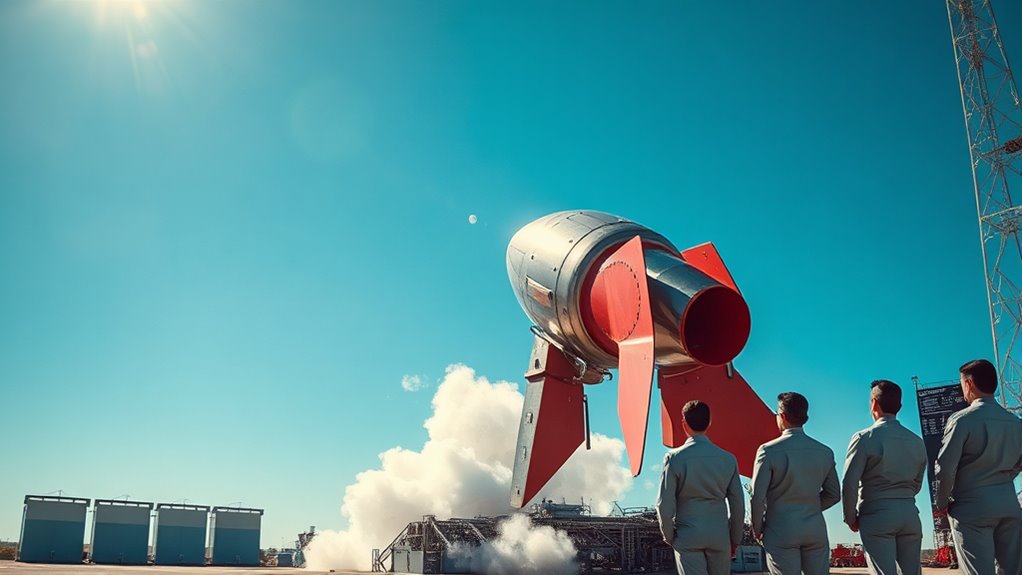
Safety Considerations in Rocket Launches
Safety considerations in rocket launches are paramount. They help mitigate the risks associated with potential failures during ignition or flight.
To guarantee a safe launch environment, several protocols are strictly followed:
- Launch sites are equipped with safety zones to keep personnel and spectators at a safe distance.
- Thorough pre-launch checks verify the integrity of all rocket components and systems.
- Fire suppression systems are installed to quickly address any fire outbreaks during fueling or launch.
- Continuous monitoring of weather conditions is critical, as adverse weather poses significant risks.
- Adherence to established protocols is essential for minimizing hazards and guaranteeing a smooth launch.
It’s all about ensuring safety every step of the way!
Educational Benefits of Launching Small Rockets
When you launch small rockets, you’re not just having fun; you’re also diving into the fascinating world of physics.
These activities provide hands-on experience with fundamental principles, like Newton’s Third Law of Motion.
You’ll learn about propulsion systems, gaining insights into how engines create thrust.
Engaging in rocket launches also boosts your critical thinking and problem-solving skills, as you design and troubleshoot your creations.
Here’s a quick overview of the educational benefits:
| Benefit | Description |
|---|---|
| Physics Principles | Understand motion and forces at play. |
| Propulsion Systems | Learn how engines generate thrust. |
| Critical Thinking | Develop problem-solving skills. |
| STEM Interest | Inspire future pursuits in science and tech. |
Frequently Asked Questions
Can Small Rockets Be Launched Indoors?
Yes, you can launch small rockets indoors, but make certain to follow safety precautions. Use low-power engines, guarantee good ventilation, and have a large, open space free of flammable materials for a safe experience.
What Age Is Appropriate for Building Small Rockets?
You can start building small rockets around age 8 with adult supervision. It’s great for kids aged 10-12 to learn about aerodynamics and propulsion, sparking their interest in STEM fields while ensuring safety.
How High Can Small Rockets Typically Fly?
Did you know some small rockets can soar over 10,000 feet? Generally, these rockets reach altitudes between 100 and 3,000 feet, depending on their design, engine power, and environmental conditions during launch.
Are There Competitions for Small Rocket Launches?
Yes, there are several competitions for small rocket launches. You can participate in events like TARC, the Spaceport America Cup, or local club contests, where you can showcase your skills and creativity in rocket design.
What Materials Are Safe for Building Small Rockets?
You should use lightweight materials like cardboard, plastic, and balsa wood for your small rocket. Non-toxic, non-flammable adhesives and safe propellants will guarantee a secure build and predictable launch, keeping everything safe during your project.
Conclusion
To summarize, small rockets are fascinating tools that blend science and creativity.
Did you know that over 1,500 amateur rocketry clubs exist worldwide? They help enthusiasts launch thousands of rockets each year!
By understanding how these rockets function, from propulsion to recovery, you not only appreciate the engineering behind them but also discover the joy of hands-on learning.
So, whether you’re a beginner or a seasoned builder, launching small rockets can ignite your passion for science and exploration!
In conclusion, small rockets serve as a perfect gateway into the world of engineering and creativity.
Engaging with rocketry not only enhances your understanding of physics but also fosters a vibrant community of like-minded individuals.
Whether through clubs or personal projects, the thrill of building and launching rockets can inspire a lifelong love for science and exploration.