What Are Montessori Toys and Why Are They Essential for Development?
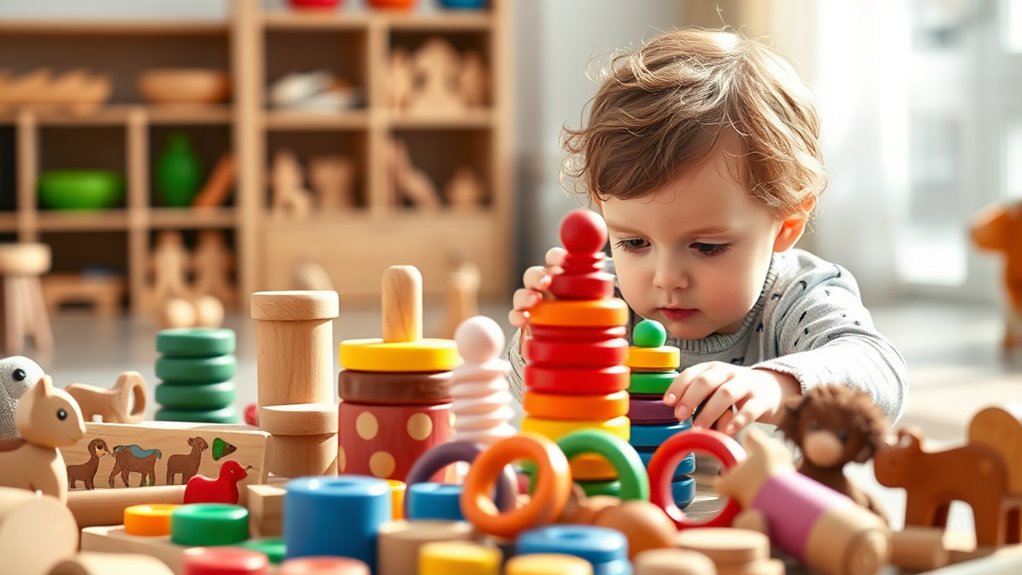
Montessori toys are specialized tools designed to promote hands-on, self-directed learning for your child. They encourage independent exploration, focusing on one skill at a time, which enhances mastery and concentration.
These toys are crafted from natural materials and are scaled to fit a child’s needs, providing authentic sensory experiences.
They play a crucial role in cognitive development, helping to improve fine motor skills while fostering social interactions.
By implementing Montessori principles, children can discover a love for learning.
There’s so much more to explore about these enriching toys!
Key Takeaways
- Montessori toys support child-centered learning, promoting hands-on experiences that allow children to develop skills at their own pace.
- Designed to isolate one developmental skill at a time, these toys enhance concentration and mastery without distractions.
- Crafted from natural materials, Montessori toys provide authentic sensory feedback, enriching tactile awareness and sensory experiences.
- Many toys feature self-correcting mechanisms, encouraging independent learning and problem-solving through immediate feedback.
- Tailored by age group, Montessori toys promote holistic development, fostering critical thinking, fine motor skills, and social interaction.
Understanding Montessori Toys
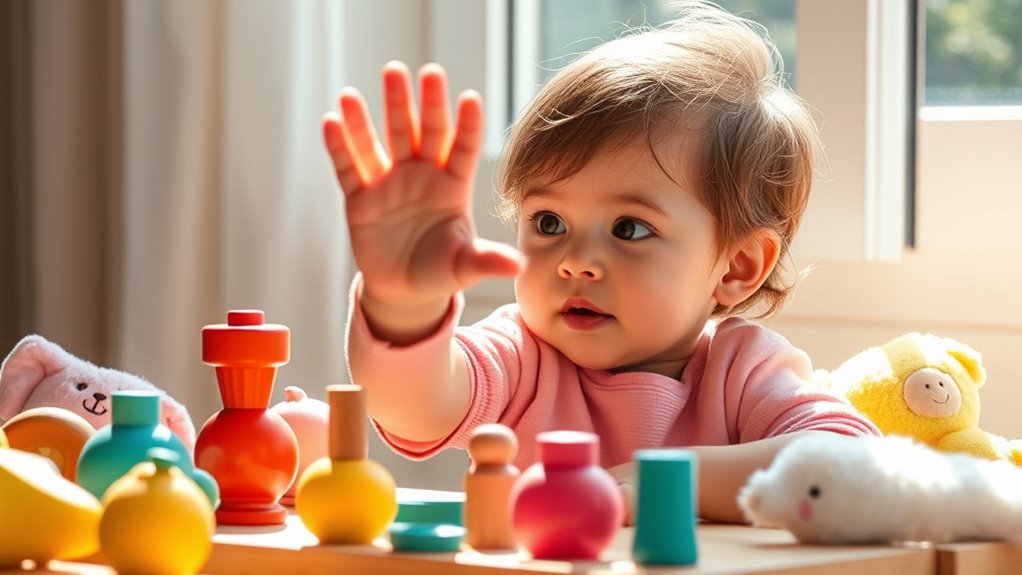
When you explore Montessori toys, you’ll discover that they’re more than just playthings; they’re crafted to support child-centered learning.
These toys encourage hands-on learning, allowing your child to explore and develop essential skills at their own pace. Designed with simplicity in mind, Montessori toys focus on isolating one developmental skill at a time, minimizing distractions and enhancing independent discovery.
Montessori toys promote hands-on learning, enabling children to develop skills independently and at their own pace.
Made from natural materials like wood and fabric, they offer authentic sensory experiences, helping children connect with real-world objects and tasks.
Additionally, many Montessori toys feature self-correcting elements, empowering your child to identify and solve problems independently.
This approach fosters independence, creativity, and confidence, making Montessori toys crucial tools for nurturing your child’s overall development.
Key Characteristics of Montessori Toys
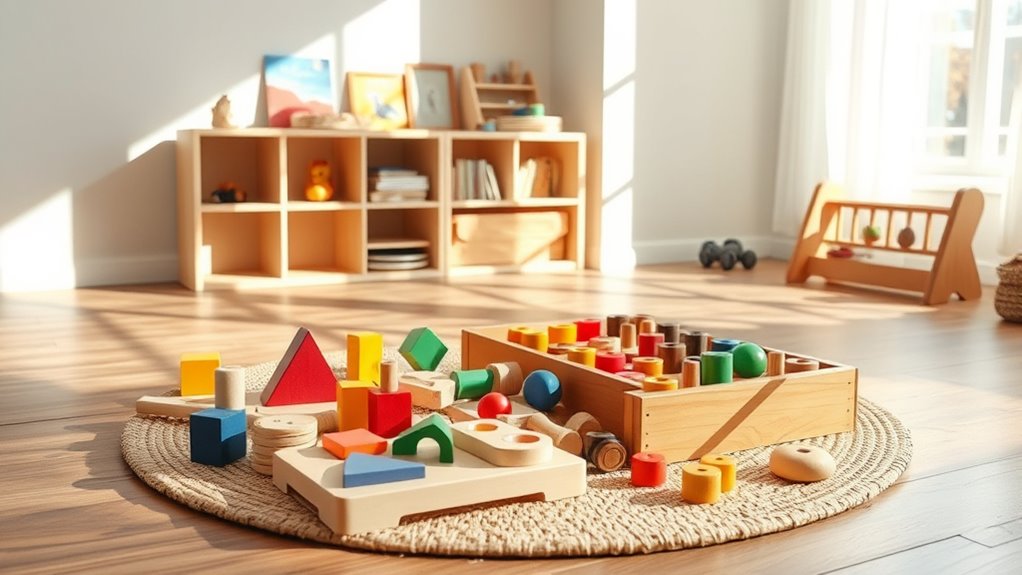
Montessori toys stand out due to their thoughtfully designed characteristics that prioritize a child’s developmental needs.
These educational toys focus on one skill at a time, minimizing distractions and allowing children to engage deeply with each concept.
Crafted from natural materials like wood and cotton, they provide authentic sensory feedback, helping kids grasp physical properties.
The child-scaled design guarantees these toys fit comfortably in little hands, promoting independent exploration.
Additionally, Montessori toys often include self-correcting mechanisms, enabling children to identify and learn from their mistakes without adult help.
Rooted in reality, they represent everyday objects and tasks, fostering a true understanding of the world around them while enhancing essential developmental skills.
The Five Tests of Montessori Toys
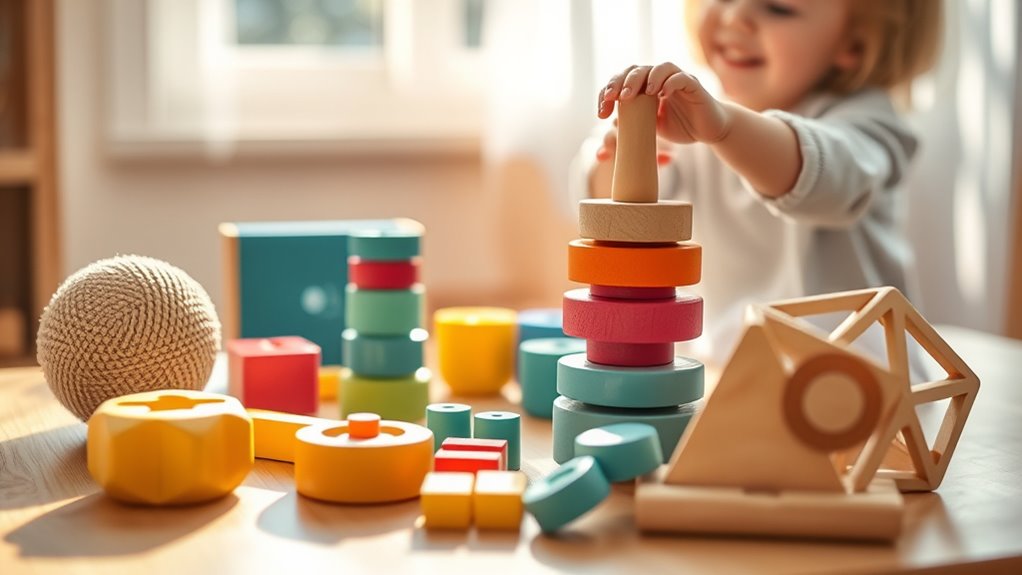
When you choose Montessori toys, look for those with self-correcting features to help your child learn from mistakes independently. These toys not only encourage problem-solving but also provide a hands-on way to understand concepts. Plus, selecting options made from natural materials enhances sensory experiences, making playtime both engaging and educational.
Self-Correcting Features Explained
Self-correcting features in Montessori toys play an important role in your child’s development, as they empower kids to identify and fix their mistakes on their own.
These toys provide immediate feedback, allowing children to understand the consequences of their actions without needing adult intervention.
By encouraging self-correction, they help foster problem-solving skills and concentration, giving kids a sense of accomplishment when they resolve challenges independently.
Montessori toys typically isolate one skill at a time, enabling your child to focus deeply on mastering that specific skill through self-correction.
This feature aligns perfectly with the Montessori philosophy that promotes independence and self-directed learning, which are essential for cognitive and emotional development in young children.
Importance of Natural Materials
Natural materials in Montessori toys play an essential role in your child’s development by providing authentic sensory experiences that enhance learning.
Toys made from wood, metal, cotton, and glass offer truthful feedback, helping your child understand the physical properties of these materials.
In Montessori education, these natural materials are vital for isolating developmental skills, allowing your child to focus on one skill at a time.
This focused approach, combined with child-scaled designs, encourages independence and self-directed exploration.
Additionally, the self-correcting nature of these toys fosters problem-solving skills and improves hand-eye coordination.
Benefits of Montessori Toys for Child Development
Montessori toys play an essential role in child development, offering numerous benefits that support various skills.
These Montessori materials encourage sorting, matching, and building activities, which enhance critical thinking and cognitive development.
As your child engages with these toys, they’ll also improve their fine motor skills through hands-on activities that require hand-eye coordination, promoting dexterity.
Additionally, Montessori toys foster social skills by encouraging collaborative play and sharing, which are essential for interpersonal interactions.
They enhance independent learning and self-reliance, featuring self-correcting elements that allow children to discover solutions on their own.
By providing challenges and opportunities for mastery, these toys help cultivate a growth mindset.
This enables your child to see difficulties as valuable learning experiences during their developmental stage.
Montessori Toys by Age Group
When choosing Montessori toys, it’s crucial to take into account your child’s age and developmental milestones. Each age group focuses on specific skills, ensuring that the toys you select support their growth and exploration. Let’s explore how these toys align with your child’s needs from infancy through early childhood.
Age-Appropriate Toy Selection
Selecting toys that align with your child’s developmental stage can greatly enhance their learning and growth.
Montessori toys are designed for specific age ranges, promoting essential developmental skills as children learn through play.
Here’s a breakdown of suitable toys for each stage:
- Infants (0-12 months): Sensory toys like mobiles and soft balls for grasping.
- Toddlers (1-2 years): Simple puzzles and cause-and-effect toys to support motor skills.
- Preschoolers (2-4 years): Chunky puzzles and role-play tools enhance fine motor skills and social interaction.
- Ages 4-6 years: Building sets and logic games encourage critical thinking and creativity.
Choosing the right toys can make a big difference in your child’s development.
Developmental Milestones Support
Understanding the importance of developmental milestones can help you choose the right Montessori toys for your child.
For infants (0-12 months), consider toys like mobiles and grasping objects that promote sensory development and visual tracking.
As your child grows into the 1-2 year range, look for cause-and-effect toys, such as pounding benches and shape sorters, to encourage early problem-solving skills.
For toddlers (2-3 years), manipulatives like bead stringing sets enhance fine motor skills and hand-eye coordination while fostering imaginative play.
When your child reaches preschool age (4-6 years), opt for building sets and sandpaper letters to support symbolic learning, critical thinking, and coordination.
These skills are all essential for their ongoing child growth and life skills development.
Skill Focus by Age
As your child grows, choosing Montessori toys that align with their developmental stage becomes crucial for nurturing essential skills.
These toys cater to specific developmental milestones, fostering child growth at each age:
- 0-12 months: Focus on sensory exploration with mobiles and soft balls, enhancing visual and auditory stimulation.
- 1-2 years: Introduce simple puzzles and cause-and-effect tools to boost cognitive abilities and hand-eye coordination.
- 2-3 years: Encourage imaginative play with chunky puzzles and role-play sets, promoting social skills and independence.
- 4-6 years: Engage deeper cognitive skills through STEM learning with building sets and logic games, enhancing creativity.
Selecting the right Montessori toys not only supports your child’s skills but also enriches their overall development journey.
Classic Montessori Toys and Their Impact
Classic Montessori toys play an essential role in your child’s development by fostering crucial skills through engaging, purposeful play.
Toys like wooden blocks and shape sorters enhance cognitive development, promoting skills such as spatial reasoning, problem-solving, and hand-eye coordination.
Designed for simplicity and functionality, these Montessori toys allow your child to focus on one skill at a time.
This design encourages deep concentration and minimizes distractions.
The natural wood materials provide authentic sensory experiences, enhancing tactile awareness and understanding of physical properties.
With self-correcting features, these toys boost your child’s confidence and sense of accomplishment as they explore and learn independently.
Ultimately, classic Montessori toys considerably impact your child’s growth, making learning both enjoyable and enriching.
Frequently Asked Questions
Are Montessori Toys Suitable for Children of All Ages?
Yes, Montessori toys are suitable for children of all ages. They encourage exploration, independence, and skill development, catering to each stage from infancy through middle school, ensuring engaging and age-appropriate learning experiences throughout childhood.
How Do I Choose the Right Montessori Toy for My Child?
Did you know that children retain 80% of what they actively engage with? To choose the right Montessori toy, focus on self-correcting designs, single-skill isolation, natural materials, appropriate sizes, and real-world representations for effective learning.
Can Montessori Toys Be Used in Traditional Educational Settings?
Yes, you can definitely use Montessori toys in traditional educational settings. They enhance independent learning, promote problem-solving, and help maintain engagement by focusing on specific skills, making them a valuable addition to any classroom environment.
Are There Any Safety Concerns With Montessori Toys?
There are minimal safety concerns with Montessori toys. They’re designed from natural materials, emphasize sturdiness, and adhere to safety standards, ensuring a safe play environment for your child while promoting learning and development.
How Can I Incorporate Montessori Principles at Home Beyond Toys?
You can incorporate Montessori principles at home by creating organized spaces, engaging in practical life activities, fostering community through group tasks, establishing uninterrupted routines, and using natural materials for authentic learning experiences.
Conclusion
In the garden of childhood, Montessori toys nurture the seeds of curiosity and creativity.
They’re not just playthings; they’re gateways to exploration and learning.
These toys help your child bloom into their fullest potential.
By choosing these thoughtfully designed toys, you’re enriching their playtime and laying a strong foundation for future growth.
Embrace this journey, and watch as your little one flourishes.
They’ll discover the world around them with joy and confidence.
Montessori toys are essential for development, promoting critical thinking and independence.
As children engage with these toys, they enhance their problem-solving skills and creativity.
Investing in Montessori toys means investing in your child’s future.
Support their growth and watch them thrive!