What Happens When a Toy Car Travels Around a Circular Track?
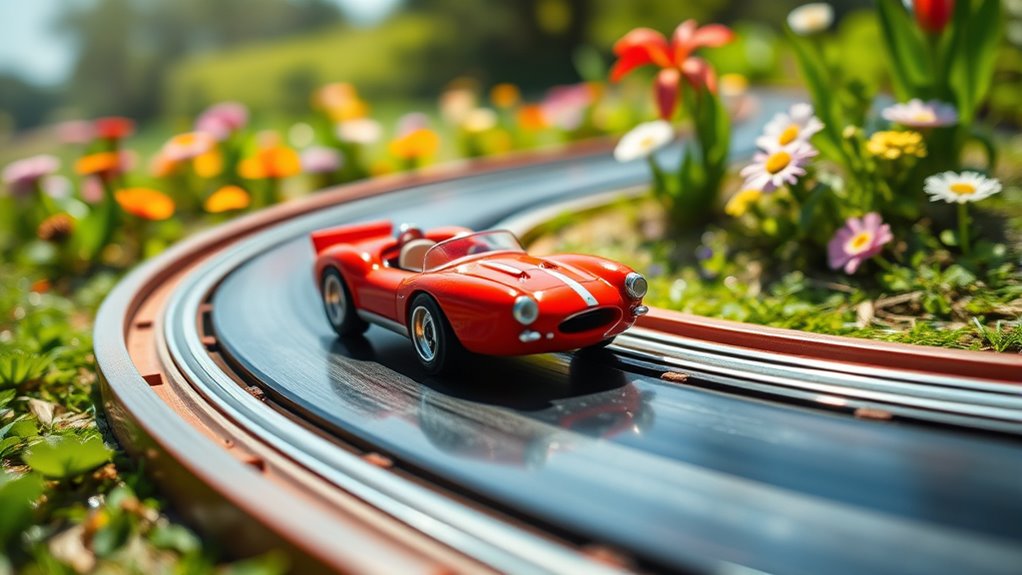
When a toy car travels around a circular track, it engages in a fascinating phenomenon known as uniform circular motion.
This means that while the car maintains a constant speed, it is always changing direction.
As the car makes its way around the track, it experiences centripetal acceleration, which pulls it toward the center of the circle.
You’ll notice that the distance from the wall varies rhythmically, reaching a maximum and minimum as it completes each lap.
This rhythmic change is part of what makes the motion so intriguing!
There’s a lot more to explore about the dynamics behind this motion and its real-world applications.
It’s amazing to think about how these principles affect everything from amusement park rides to the orbits of planets.
Key Takeaways
- The toy car maintains a constant speed while changing direction along the circular track.
- Centripetal acceleration keeps the car moving in a circular path, directed toward the track’s center.
- As the car’s speed increases, the centripetal acceleration increases, requiring more force to maintain the circular motion.
- The distance from the track’s wall affects the car’s path and the pattern of motion observed.
- Graphing the distance from the wall over time reveals a periodic V-shaped pattern representing the car’s motion.
Understanding Uniform Circular Motion
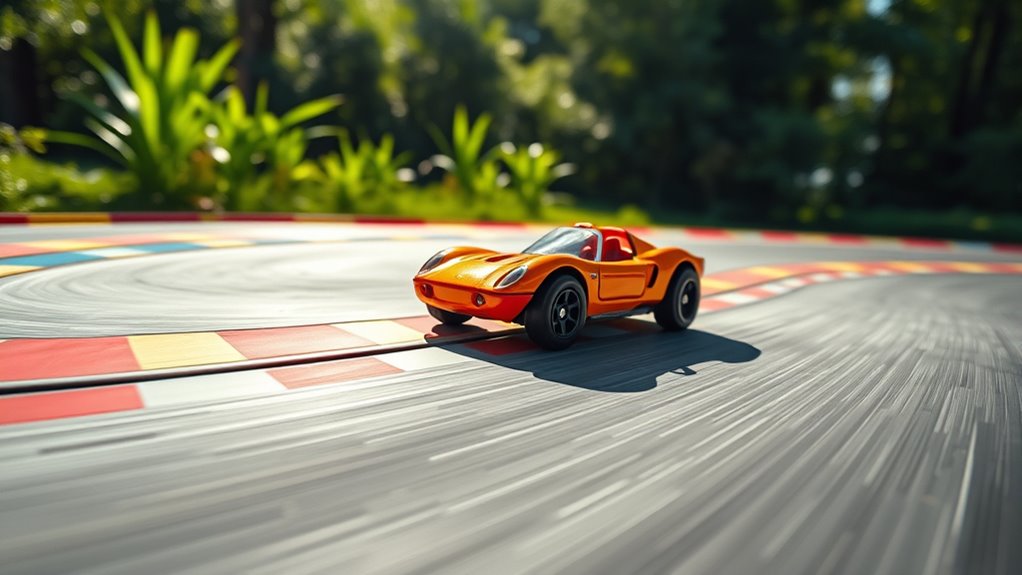
Uniform circular motion is a fascinating phenomenon where an object, like a toy car, travels at a consistent speed along a circular path.
Even though the car maintains a constant speed, its velocity isn’t constant because the direction of motion keeps changing.
This change in direction leads to what we call centripetal acceleration, which always points toward the center of the circle.
You can calculate this acceleration using the formula ( a = frac{v^2}{r} ), where ( v ) represents the car’s speed and ( r ) is the radius of the circular path.
As you watch the toy car travel, notice how the distance from the wall affects its path.
It’s interesting how it keeps in a perfect circle while accelerating towards the center.
The Role of Velocity and Acceleration
As the toy car moves around the circular track, its velocity and acceleration play essential roles in keeping it on that path.
The car travels at a constant speed, which means its velocity’s magnitude remains unchanged.
However, the direction of that velocity continuously shifts, resulting in acceleration toward the center of the circle—known as centripetal acceleration.
Here’s a quick overview:
| Concept | Description |
|---|---|
| Velocity | Constant speed while changing direction |
| Centripetal Acceleration | Directed toward the circle’s center (a = v²/r) |
| Impact of Speed | Doubling speed increases centripetal acceleration by four times |
Understanding these concepts is vital for grasping how circular motion works.
The dynamics of velocity and acceleration keep the car on its circular path!
Analyzing Distance Variation Over Time
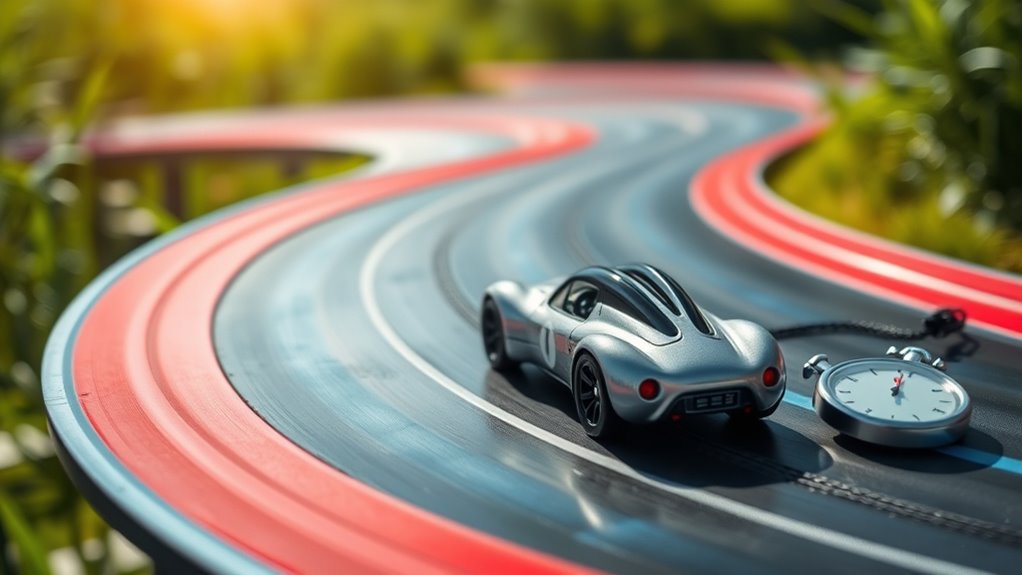
When observing the toy car on the circular track, you’ll notice that the distance from the wall changes in a rhythmic pattern as it completes each lap.
The distance increases until it reaches a maximum, then decreases back to zero, creating a cyclical motion.
As the car travels around, this behavior can be represented as a downward-opening V shape on a graph.
Each lap consists of three distinct segments, reflecting the car’s constant rate of movement.
The maximum distance occurs at the farthest point from the wall, while the minimum is when it returns.
Analyzing this periodic variation helps you understand the toy car’s dynamics and the relationship between time and distance relative to the wall.
Graphical Representation of Motion
Understanding the graphical representation of the toy car’s motion on the circular track reveals the rhythmic pattern of its distance from the wall.
As the car travels around the track, the graph displays a periodic V-shaped pattern, where each V represents a complete lap.
The y-axis indicates the distance from the wall, while the x-axis tracks the time elapsed.
You’ll notice the distance increases to a maximum before returning to zero, demonstrating the car’s proximity to the wall at each lap’s end.
This visual representation simplifies how the car’s motion correlates with changes in distance from the wall over time.
It makes it easier to grasp the dynamics of circular motion.
Real-World Applications of Circular Motion
Circular motion plays an essential role in various real-world applications, from the design of vehicles to amusement park rides.
Understanding how centripetal acceleration affects objects on a circular track is vital for safety and efficiency.
Centripetal acceleration is crucial for ensuring safety and efficiency in circular motion applications.
Here are some key areas where circular motion principles are applied:
- Vehicle Design: Engineers guarantee cars can handle turns safely by applying circular motion concepts.
- Amusement Park Rides: Designers calculate forces to create thrilling yet safe experiences.
- Sports Performance: Athletes optimize their techniques in cycling and track events that involve curves.
It’s fascinating how these principles come together in everyday life!
Key Concepts in Circular Dynamics
When you’re watching a toy car race around a circular track, you’re witnessing the fundamentals of circular motion in action. The car experiences constant speed, but its direction changes, creating acceleration directed toward the center of the circle. This relationship between velocity and acceleration is key to understanding how the car navigates the track.
Circular Motion Fundamentals
As a toy car glides effortlessly around a circular track, it showcases the fascinating principles of circular motion.
Even as it travels at a constant speed, the car’s velocity vector keeps changing direction, revealing the dynamics at play.
Here are some key concepts to understand:
- Centripetal acceleration always points toward the center of the circular track.
- The formula for centripetal acceleration is a = v²/r, where v represents constant speed and r is the radius.
- The displacement during circular motion can be calculated using d = v × Δt, which factors in the time interval.
Despite maintaining a steady speed, the continuous change in the velocity vector means the toy car is always accelerating.
This really emphasizes the uniqueness of circular motion!
Acceleration Towards Center
Understanding how a toy car navigates a circular track leads us to the concept of acceleration towards the center, known as centripetal acceleration.
Even when the car moves at a constant speed, it’s still accelerating because its direction changes continuously.
This acceleration is always directed towards the center of the circle, and its magnitude depends on the speed of the car and the distance from the center, or radius.
The formula for centripetal acceleration is a = v²/r.
If you double the car’s speed, the centripetal acceleration increases by a factor of four, greatly impacting the forces at play.
Picture the car hugging the wall of the track, constantly pulled inward, maintaining its circular path.
Velocity Changes Explained
While maneuvering a circular track, a toy car demonstrates how velocity changes even at a constant speed.
Although the car’s speed remains unchanged, its direction of motion continuously alters, resulting in a change in velocity. This change is directed towards the center of the circle, creating centripetal acceleration, which keeps the car on its curved path.
Here are some key points to remember:
- The velocity vector is always tangent to the circular path.
- Centripetal acceleration can be calculated using (a = v²/r).
- Doubling the speed increases centripetal acceleration by a factor of four.
Understanding these concepts helps clarify how velocity changes during circular motion despite a constant speed.
Frequently Asked Questions
How Does Friction Affect a Toy Car on a Circular Track?
Friction helps your toy car grip the circular track, allowing it to maintain its path. If there’s too little friction, the car skids and loses control, especially in sharp turns, affecting its speed and stability.
What Materials Are Best for a Circular Track?
For a circular track, you’ll want smooth plastic or wood for low friction, while rubber offers shock absorption. A solid base guarantees stability, and textured surfaces enhance grip, improving your toy car’s performance around curves.
Can a Toy Car Go Faster on a Larger Track?
A larger track can increase a toy car’s speed, as its circumference allows for greater distance in the same time. You’ll notice the car’s performance improves, especially if it’s built for higher speeds.
How Do Different Weights Impact the Car’s Motion?
Different weights impact your car’s motion by affecting its inertia. Heavier cars need more force to change speed or direction, while lighter ones can accelerate quicker and maintain better grip on the track during turns.
What Safety Measures Should Be Considered When Using Toy Cars?
When using toy cars, you should check for sharp edges, guarantee they’re made of non-toxic materials, supervise play, use them on flat surfaces, and store them safely to prevent accidents and maintain an organized play area.
Conclusion
As you watch the toy car zip around the circular track, you can’t help but wonder what forces are at play.
The thrill of its constant speed hides the unseen acceleration, pulling it toward the center.
What happens when it speeds up or slows down? Will it stay on the track, or will it veer off course?
The mystery of its motion keeps you on the edge of your seat, inviting you to explore the fascinating world of circular dynamics further.
In conclusion, observing a toy car on a circular track reveals crucial concepts of motion, speed, and acceleration.
Understanding how forces interact in circular dynamics helps explain why the car stays on course or may fly off if its speed changes.
So next time you see a toy car racing around a track, think about the exciting physics behind its journey!