Top 10 Model Rocket Starter Sets for New Enthusiasts
If you’re new to model rocketry, it’s essential to select kits that align with your skill level to ensure a fun and engaging experience.
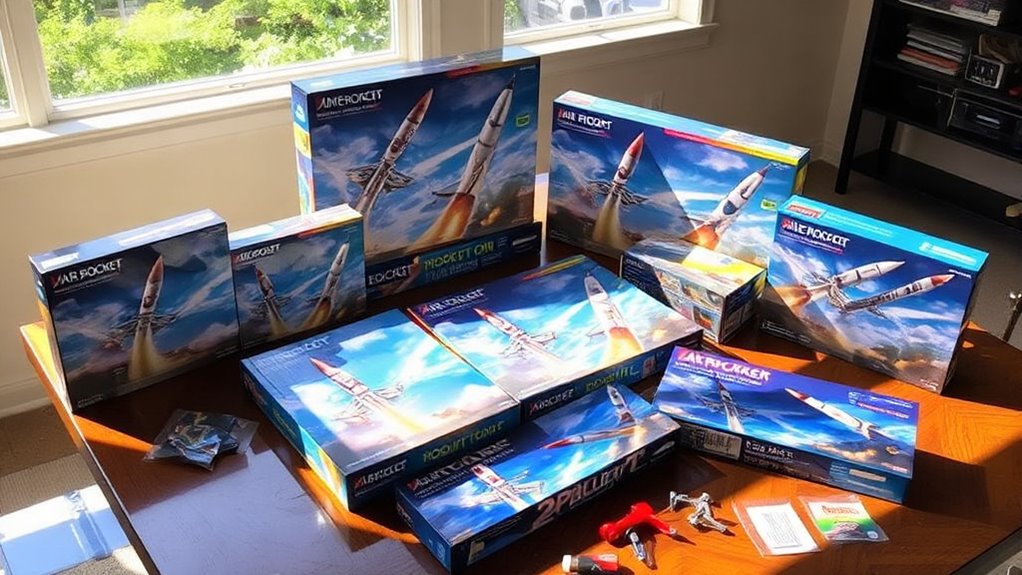
The Estes Alpha III Launch Set is a fantastic choice for beginners, as it provides everything you need to get started.
Meanwhile, Apogee Components kits deliver excellent educational value, making them perfect for those keen to learn more about rocketry.
If you’re looking for budget-friendly options, Quest kits are great for family fun and exploration.
As you dive into different kits, you’ll uncover exciting features and important considerations that can elevate your launching experience.
So, keep reading to discover more about these amazing starter sets!
Key Takeaways
- The Estes Alpha III Launch Set is ideal for beginners, offering easy assembly and quick launch readiness within an hour.
- Quest rockets provide affordable options, making them suitable for educational settings and family activities.
- Apogee Components kits focus on aerodynamics, enhancing educational value through hands-on building experiences.
- Stomp Rocket offers a safe, foam-based launching system that requires no complex assembly, perfect for small spaces.
- Advanced kits like LOC Precision are designed for experienced users, featuring heavy-duty airframes and compatibility with higher power motors.
Choosing the Right Skill Level
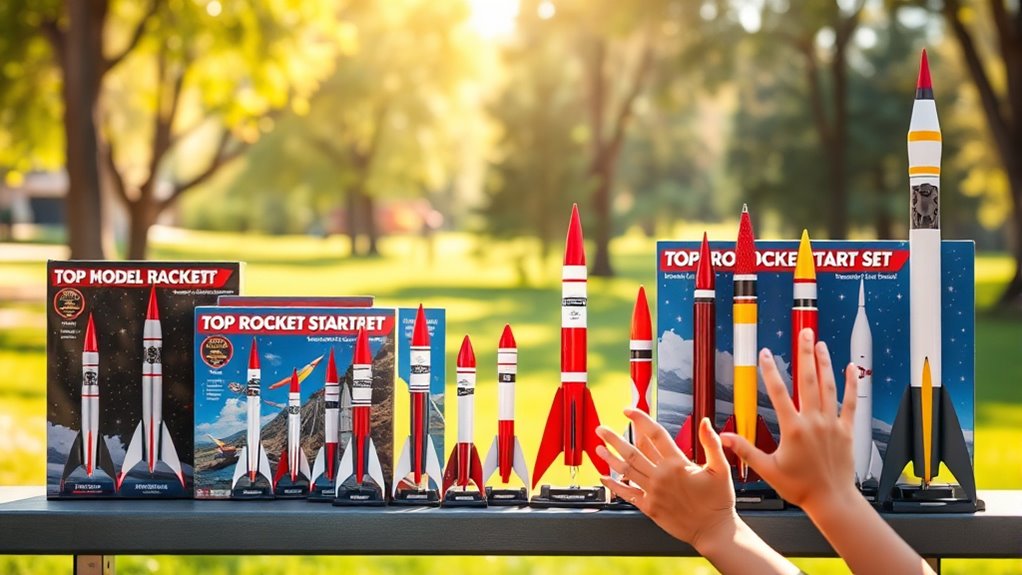
When you’re diving into model rocketry, it’s essential to choose a kit that matches your skill level. This way, you can enjoy the experience without feeling overwhelmed.
If you’re a beginner, consider starting with the Estes Alpha III Launch Set; it’s easy to assemble and can be ready in under an hour.
For those interested in STEM education, Apogee Components kits offer valuable lessons on aerodynamics and physics.
Families launching model rockets might prefer Quest kits, which are cost-effective and perform reliably during group activities.
As you gain confidence, you might explore LOC Precision kits for mid-to-high power flights.
Always select a kit suitable for your age and experience to guarantee a successful and enjoyable entry into model rocketry.
Best Overall and Beginner-Friendly Kits
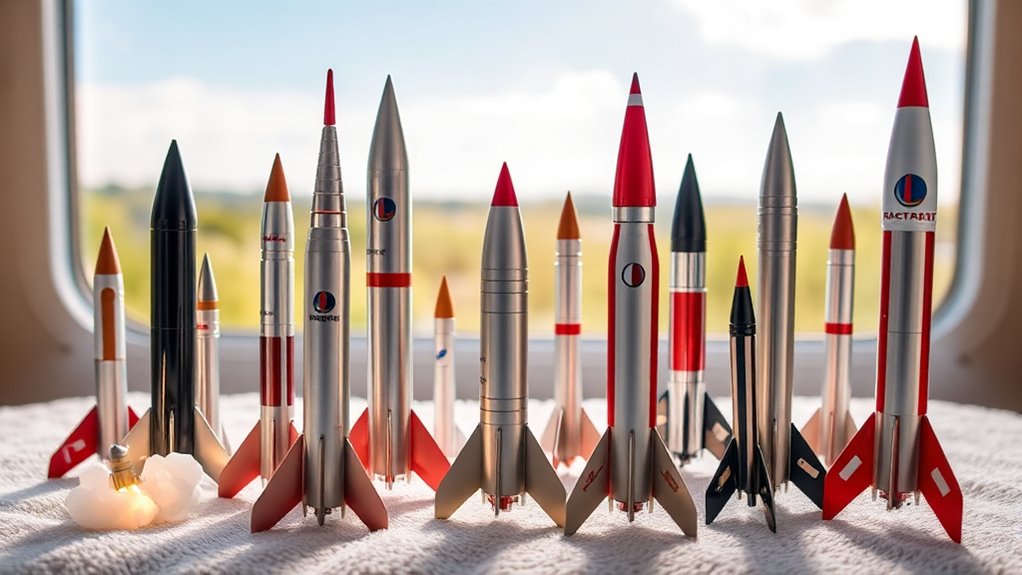
When you’re starting out in rocketry, you want a kit that’s easy to assemble and built to last. The Estes Alpha III Launch Set is perfect for this, as it can be put together in under an hour with its durable, pre-colored parts. Both Estes and Quest kits offer reliable performance, making them great choices for beginners enthusiastic to explore the world of model rocketry.
Easy Assembly Process
For anyone diving into the world of model rocketry, easy assembly is a crucial factor, especially for beginners.
The Estes Alpha III Launch Set stands out with its straightforward assembly process, allowing you to put it together in under an hour. Its pre-colored, blow-molded plastic parts guarantee both durability and simplicity.
You’ll appreciate that this kit includes the Estes Porta-Pad II launch pad and Electron Beam launch controller, making it a complete package for novices.
Alternatively, Quest rockets also offer an affordable and dependable option, often favored in educational settings.
With both Estes and Quest kits prioritizing ease of assembly and safety, you’ll find them ideal for families and individuals enthusiastic to explore this exciting hobby.
Durable Construction Materials
Building on the ease of assembly, durable construction materials play a significant role in enhancing the overall experience for new rocketeers.
The Estes Alpha III Launch Set, crafted with blow-molded plastic, offers exceptional durability, ensuring it withstands the excitement of multiple launches.
You’ll appreciate how this starter kit features pre-colored parts that allow for quick assembly in under an hour, making it perfect for newcomers.
Additionally, Quest rockets are known for their cost-effectiveness and sturdy design, appealing to families and educators alike.
Both Estes and Quest utilize high-quality materials that guarantee your rockets can handle the rigors of repeated use.
With these durable construction materials, you can confidently initiate your rocketry journey.
Educational and STEM-Focused Kits
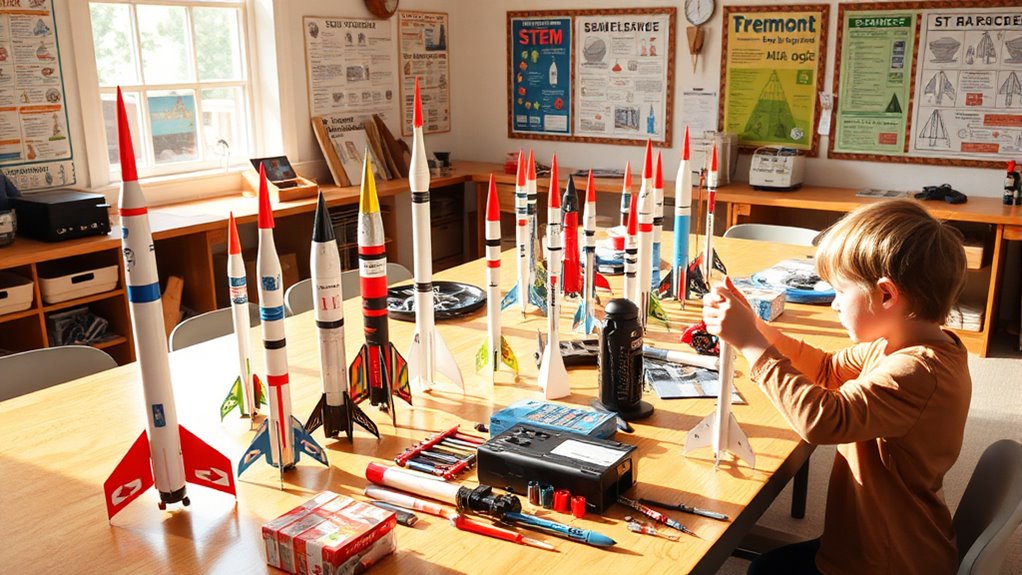
Educational and STEM-focused kits offer a fantastic way to engage with the principles of flight and engineering while having fun.
Apogee Components kits are perfect for this. They teach you the fundamentals of aerodynamics and rocket construction through hands-on assembly.
You’ll spend one to two hours building your rocket, all while learning about physics and flight dynamics.
For those looking for a simpler experience, Stomp Rocket provides a safe, foam-based launching system that requires no complex assembly.
It’s ideal for small backyards and even indoors, allowing kids to explore cause-and-effect concepts without ongoing costs.
Plus, you can experiment with variations, like using baking soda for fun, educational projects.
These kits make learning exciting and accessible!
Advanced and Transitioning Kits
If you’re ready to step up your rocketry game, advanced kits like those from LOC Precision offer heavy-duty airframes that can handle mid-to-high power flights. These kits are compatible with larger G and H class motors, giving you the chance to experience more ambitious launches. As you shift to more advanced models, you’ll appreciate the enhanced stability and structural integrity these kits provide.
Heavy-Duty Airframe Benefits
When you’re ready to take your rocketry to the next level, heavy-duty airframes offer significant advantages for both advanced enthusiasts and those moving from beginner kits.
Here’s what you can expect:
- Enhanced Durability: Heavy-duty cardboard airframes withstand mid-to-high power flights and rough landings.
- Powerful Launches: These airframes accommodate larger G and H class motors for longer flight durations.
- Improved Stability: Through-the-wall fin assemblies enhance stability, which is essential for high-altitude flights without compromising safety.
- Advanced Features: Many kits support electronics bays for altimeters and GPS tracking. This is ideal for serious rocketry enthusiasts.
With a heavy-duty airframe, you’ll enjoy a more robust and thrilling rocketry experience.
This makes your shift smoother and more rewarding.
Suitable Motor Compatibility
As you progress in your rocketry journey, understanding suitable motor compatibility is essential for maximizing your flight experience.
Advanced and evolving kits, like those from LOC Precision, support larger G and H class motors, releasing the potential for impressive altitude and power.
Unlike beginner kits that use A8-3 or B6-4 motors, these advanced kits are engineered for composite motors, enhancing performance considerably.
They feature heavy-duty cardboard airframes and through-the-wall fin assemblies, ensuring stability during those higher impulse flights.
Evolving kits also require a compatible launch pad to handle the necessary ignition systems.
Remember, safety is paramount—larger motors demand bigger launch areas and strict adherence to regulations.
Knowing suitable motor compatibility keeps your launches safe and successful!
Display and Scale Models
Display and scale models offer a fantastic way to appreciate the intricacies of rocket design without the need for extensive hands-on assembly.
One standout option is the Estes NASA SLS, a 1:200 scale replica of the Artemis Moon rocket, perfect for display.
Here are four reasons to weigh these models:
- Minimal Assembly: Quickly showcase your rocket without complex construction.
- Aesthetic Appeal: Enhance your desk or shelf with a stunning decorative piece.
- Educational Value: Ideal for space history enthusiasts and young kids fascinated by space exploration.
- Nose Cone Detail: Admire the intricate design elements, including the nose cone, that make these models visually impressive.
These models are perfect for anyone looking to celebrate the beauty of rocketry!
Safety and Launching Considerations
Ensuring a safe launch environment is essential for a successful rocket experience.
You should choose a launch site that’s at least 50 feet wide, ideally a 500×500-foot area, to allow for recovery.
Avoid launching from small suburban backyards; rockets can easily drift into neighboring properties.
Pay attention to wind conditions, as even light breezes can alter your rocket’s trajectory.
Be mindful of wind conditions, as even gentle breezes can significantly change your rocket’s flight path.
Always adhere to safety guidelines by keeping spectators behind a designated safety line.
It’s also wise to steer clear of trees, buildings, or any obstacles to minimize the risk of losing your rocket or causing damage.
Brands to Avoid for Beginners
When you’re starting out in model rocketry, it’s best to steer clear of brands like Public Missiles Ltd., which cater to advanced rocketry and can overwhelm you with complexity. You should also be cautious of overpriced novelty kits from National Geographic that don’t deliver the quality you need. Sticking to reliable, hobby-grade options will give you a much better launching experience.
Advanced Rocketry Limitations
While diving into model rocketry can be exciting, certain brands are best avoided if you’re just starting out.
These brands often present advanced rocketry limitations that can frustrate beginners.
Here are four to steer clear of:
- Public Missiles Ltd. – Their complex designs are meant for seasoned rocketeers, not novices.
- GoPro Payloads – Adding these can drastically change flight dynamics, increasing the risk of failure.
- National Geographic Kits – Often overpriced and lacking in quality, they don’t provide reliable performance.
- Rebranded Low-Quality Options – These can lead to a disappointing introduction to the hobby.
Focusing on reputable, hobby-grade brands will guarantee a rewarding experience as you explore model rocketry.
Overpriced Novelty Concerns
Steering through the world of model rocketry can be tricky, especially with brands that package overpriced novelty kits as beginner-friendly options.
Brands like National Geographic often fall into this category, offering toys that lack the quality and performance you’d expect from true hobby-grade rockets.
Additionally, Public Missiles Ltd. is strictly for advanced enthusiasts, presenting complexity and safety risks unsuitable for beginners.
Many beginner kits from lesser-known brands may skimp on essential features, resulting in poor flight performance.
Be cautious of misleading rebranded options that promise a legitimate hobby experience but deliver disappointment.
Even payloads like GoPro can negatively impact flight dynamics, making them a risky choice for novice builders.
Avoid these overpriced novelty concerns to guarantee a rewarding start.
Understanding Rocket Engine Codes
Understanding rocket engine codes is essential for anyone looking to launch a model rocket successfully.
Understanding rocket engine codes is crucial for a successful model rocket launch.
These codes help you choose the right engine for peak performance.
Here’s a quick breakdown:
- Letter: Indicates power level (A = lowest, B = double A, etc.).
- Number: Represents average thrust in Newtons (e.g., B6-4 means 6 Newtons).
- Suffix: Shows delay time before the recovery system activates (e.g., “3” means a 3-second delay).
- Launch Controller: You’ll use this to ignite the engine, ensuring it matches your engine’s specifications for a safe launch.
Understanding these components will help you make informed choices for your rocket launches.
Happy launching!
Recovery Systems Explained
Recovery systems play an essential role in model rocketry, ensuring your rocket returns safely to the ground after its flight.
Typically, these systems use parachutes or streamers that deploy at the peak of ascent. For larger rockets, the recovery system needs to be more robust to handle greater altitudes and weights.
Many beginner kits, like the Estes Alpha III, come with a pre-configured recovery system, making it easier for you to launch.
Parachute recovery systems utilize a small ejection charge that ignites at apogee, pushing the recovery device out of the rocket body.
Don’t forget to include recovery wadding to protect the parachute from the heat of the ejection charge.
Improper deployment can lead to damaged rockets or lost models, so it’s an important step!
Launch Pads and Controllers
When you’re ready to launch your model rocket, having the right launch pad and controller is essential for a successful flight.
Here are some key features to look for:
- Stability: Choose launch pads like the Estes Porta-Pad II for easy setup and stable launches.
- Safety: Opt for controllers such as the Electron Beam, which often include safety interlocks to prevent accidental ignition.
- Compatibility: Many starter kits come with bundled launch pads and controllers, providing a complete system right out of the box.
- Proper Alignment: Verify you align your rocket correctly on the launch pad, as this affects its trajectory and stability during ascent.
With the right launch pads and controllers, you’re set for an exciting launch experience!
Frequently Asked Questions
How Much Time Does It Take to Assemble a Starter Rocket Kit?
Assembling a starter rocket kit typically takes you about one to three hours, depending on the complexity of the kit. You’ll enjoy the process, so take your time and savor each step!
What Age Is Appropriate for Children to Start Model Rocketry?
Model rocketry can ignite a child’s curiosity around age 8. At this age, they’re usually enthusiastic to learn and follow instructions, making it a perfect time to explore the excitement of launching rockets together.
Can I Launch Rockets in My Backyard?
You can launch rockets in your backyard, but check local regulations first. Make certain you have enough space, a safe launch area, and that you’re following safety guidelines to avoid any accidents or issues.
What Materials Are Commonly Used in Model Rocket Kits?
Model rocket kits commonly use lightweight materials like balsa wood, plastic, and cardboard for the body and fins. You’ll also find engines made from composite propellant, recovery wadding for the parachute, and launch pads included.
Are There Competitions for Beginner Model Rocketry Enthusiasts?
Yes, there are competitions for beginner model rocketry enthusiasts. You can participate in local events or national contests, where you’ll showcase your skills, meet fellow hobbyists, and gain valuable experience while having fun.
Conclusion
To summarize, choosing the right model rocket starter set can ignite your passion for rocketry. Did you know that nearly 70% of new enthusiasts report feeling a thrill when launching their first rocket?
Whether you opt for a beginner-friendly kit or something more advanced, the joy of seeing your creation soar is unmatched.
So, grab your gear, and get ready to launch into an exciting new hobby. You’ll be amazed at what you can achieve!
In conclusion, selecting the perfect model rocket starter set is crucial for new enthusiasts. It not only enhances your experience but also boosts your confidence as you explore rocketry. Remember, the thrill of launching your first rocket is just the beginning. With the right kit, you’ll unlock endless possibilities and adventures in this fascinating hobby. So, get ready to embark on your rocketry journey and watch your creations reach new heights!